




What's Happening?
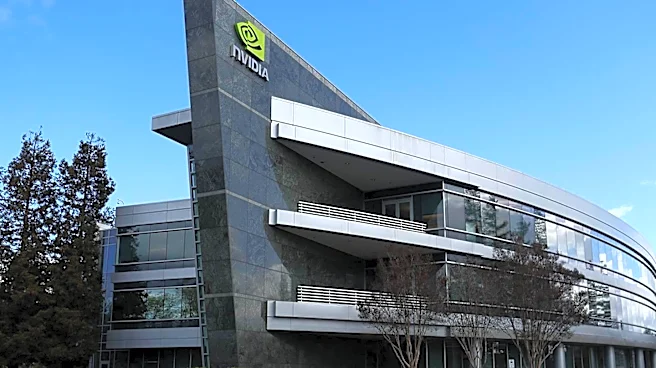
Bank of America analysts are suggesting that Nvidia's stock is currently undervalued, despite its proximity to an all-time high set on May 14th. The analysis, which compares Nvidia to peers like Marvel and AMD, focuses on a sum-of-parts free cash flow
valuation. While competitors are trading at 46 to 49 times their 2027 multiples, Bank of America's calculations indicate that Nvidia should be trading significantly higher. This assessment takes into account Nvidia's 'circular financing deals,' and even after impairing 50% of its cash flow, the company still presents strong financial figures. The report highlights that if Nvidia were to increase its stock buybacks, it could alleviate concerns regarding these financing deals by returning cash flow directly to shareholders. This move would align Nvidia more closely with some of its peers who have historically engaged in more aggressive buyback programs.
Why It's Important?
This analysis is significant for investors and the broader technology sector, particularly in the context of artificial intelligence (AI) and semiconductor industries. Nvidia's valuation directly impacts market sentiment and investment strategies for companies heavily involved in AI development and hardware. If Nvidia is indeed undervalued, it suggests a potential upside for investors, which could lead to increased capital flow into the semiconductor market. Furthermore, the discussion around stock buybacks and the deployment of free cash flow highlights a critical aspect of corporate finance and shareholder value. Increased buybacks could signal confidence from the company's management and potentially boost stock prices, benefiting current shareholders. Conversely, a lack of such actions might lead to continued skepticism, despite strong underlying financial performance. The comparison with Marvel and AMD also provides a benchmark for evaluating growth potential and market multiples within the competitive tech landscape.
What's Next?
Investors will be closely watching Nvidia's upcoming earnings call for two key pieces of information: the company's plans regarding stock buybacks and details on its investments, particularly off-balance-sheet investments and their accounting treatment. An increase in buybacks could be a strong catalyst for the stock, addressing concerns about cash flow deployment and potentially driving the stock price higher in line with Bank of America's valuation. Clarity on investment strategies will also provide insight into Nvidia's future growth trajectory and its commitment to expanding its market presence in AI and other advanced technologies. The market will be looking for signals that Nvidia is actively working to enhance shareholder value and maintain its competitive edge, especially as the AI sector continues to evolve rapidly. The outcomes of these discussions could significantly influence Nvidia's stock performance and investor confidence in the short to medium term.
Beyond the Headlines
The debate over Nvidia's valuation and its financial strategies touches upon deeper implications for the tech industry and corporate governance. The concept of 'circular financing deals' and their impact on free cash flow raises questions about transparency and the true financial health of rapidly growing tech giants. The emphasis on stock buybacks as a mechanism to return value to shareholders also highlights a broader trend in corporate America, where companies often prioritize share price appreciation over other forms of investment or dividend payouts. This approach can influence how companies allocate capital, potentially affecting long-term innovation and job creation. Moreover, the market's evolving perception of AI-driven companies, moving from initial excitement to more rigorous financial scrutiny, suggests a maturing investment landscape. This shift demands greater accountability and clearer communication from companies like Nvidia regarding their financial practices and future outlook, setting a precedent for other firms in the high-growth tech sector.