






What's Happening?
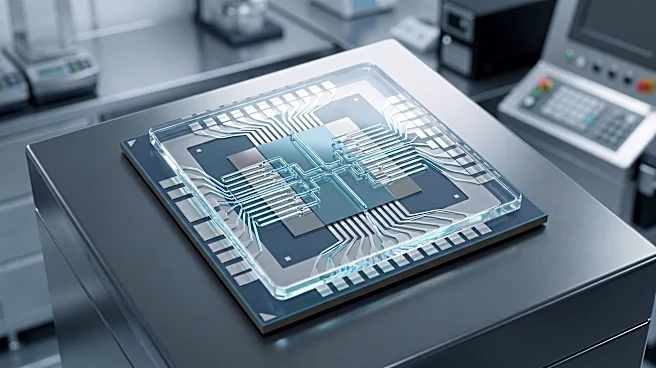
Atomica has launched its AI Thermal Microstructures Platform, a microfabrication offering designed to integrate thermal management directly into advanced AI chip packages and related hardware. This platform aims to address the significant challenges posed
by extreme power density and steep thermal gradients in high-density AI compute and photonic systems. Traditional external cooling methods, such as heat sinks and cold plates, are becoming insufficient as chip packages become denser. Atomica's new platform provides microfabricated building blocks for package-level thermal control, including microfluidic cooling, thermal pathways, interposers, and sensing structures. These components are intended to route coolant close to hotspots, spread heat efficiently, monitor pressure and flow, and isolate temperature-sensitive components. The platform is Atomica's fourth AI infrastructure offering, following its AI Optical Connectivity, AI Optical Source, and AI Photonic Integration platforms. The company emphasizes that as lasers and optical engines are integrated closer to processors and switches, managing temperature gradients and thermal drift becomes critical for performance and stability.
Why It's Important?
The introduction of Atomica's AI Thermal Microstructures Platform is crucial for the advancement of high-performance computing, particularly in the rapidly evolving fields of artificial intelligence and photonics. As AI models become more complex and demand greater computational power, the heat generated by these chips increases exponentially. Inadequate thermal management can lead to performance degradation, reduced chip lifespan, and system instability. By embedding microfluidic cooling directly into the chip package, Atomica is enabling the development of more powerful and reliable AI accelerators, GPU and chiplet packages, and high-bandwidth memory integrations. This innovation is vital for data centers, edge-AI systems, industrial electronics, and defense systems, where maintaining optimal operating temperatures is paramount. The ability to manage thermal issues at the package level will allow for continued scaling of computational density, preventing thermal bottlenecks from hindering the progress of AI and other advanced computing technologies. This directly impacts the U.S. technology sector's ability to innovate and compete globally in AI hardware development.
What's Next?
Atomica plans to work with customers through various stages, starting with feasibility structures and thermal test vehicles, progressing to engineering samples, functional prototypes, qualification lots, and ultimately scalable production. This phased approach suggests a collaborative development process with industry partners to tailor the microfluidic cooling solutions to specific application needs. The company anticipates that its platform will support a wide range of use cases, including liquid-cooled AI accelerator modules, photonic interposers, optical engines, and co-packaged optics. The integration of thermal control features within advanced packages is expected to become a standard practice as power densities continue to rise. Future developments will likely focus on refining these microfabrication techniques, improving the efficiency of microfluidic cooling, and expanding the platform's compatibility with emerging chip architectures. The success of this platform could lead to a paradigm shift in how thermal management is approached in high-performance computing, moving from external solutions to integrated, package-level designs.
Beyond the Headlines
The shift towards integrated, package-level thermal management, as exemplified by Atomica's platform, signifies a deeper trend in semiconductor design: the increasing convergence of different engineering disciplines. Thermal, optical, and electrical engineering are no longer separate considerations but are becoming intrinsically linked at the micro-scale. This holistic approach is essential for overcoming the physical limitations of Moore's Law and enabling the next generation of computing. The ethical implications revolve around the environmental impact of increased power consumption and the need for sustainable cooling solutions. While microfluidic cooling is more efficient, the energy required to power these systems still needs to be considered. Legally, intellectual property surrounding these advanced microfabrication techniques will become increasingly valuable and contested. Culturally, this innovation underscores the relentless pursuit of performance in the tech industry, pushing the boundaries of what is physically possible and driving the demand for highly specialized engineering talent. The long-term shift could see a complete redesign of data center infrastructure to accommodate these highly integrated and liquid-cooled components.