





What's Happening?
OpenAI has launched its new large language models, GPT-6.2 Astra and GPT-6.2 Sol, with Astra positioned as the frontier model for complex projects and Sol as a more affordable option for everyday tasks. Both models became available on Tuesday across ChatGPT
Work, Codex, and the API. OpenAI claims Astra is the first model to meet its 'High' threshold for AI self-improvement and asserts it is the 'best model in the world for scientists.' The company has also reduced the price of its top model by 20%. However, early testers have expressed mixed reactions. Research group Epoch AI found Astra trailed Anthropic’s Claude Fable 5.2 on realistic work tasks, scoring 65% compared to Fable 5.2's 98% on an AI data center analysis. Developer Theo Browne stated he would not choose Astra over Anthropic’s Opus 5.5 for his development work, citing a 56% slowdown in a TypeScript compiler rewrite.
Why It's Important?
The release of GPT-6.2 Astra and Sol is significant as it marks OpenAI's latest attempt to maintain its leadership in the rapidly evolving AI landscape. The claim of Astra being the first model to achieve a 'High' threshold for AI self-improvement could signal a new era of more autonomous and capable AI systems, potentially accelerating research and development across various scientific and technical fields. The price reduction for the top model also indicates a strategic move to make advanced AI more accessible, potentially increasing adoption rates among businesses and developers. However, the mixed early reviews, particularly the underperformance against competitors like Anthropic's models in certain realistic tasks, highlight the intense competition and the ongoing challenge of delivering consistently superior performance across diverse applications. This feedback could influence future development priorities for OpenAI and impact market perception.
What's Next?
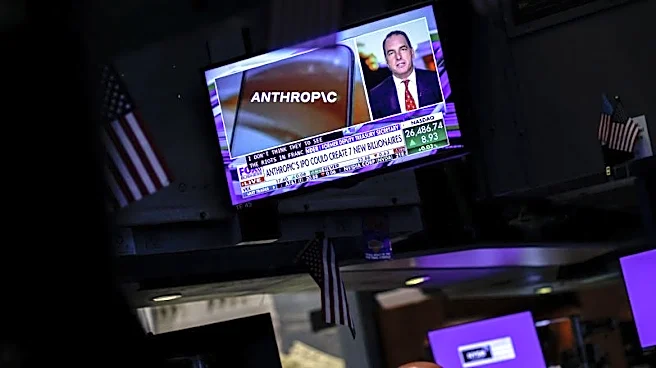
Following the launch, OpenAI will likely be closely monitoring user feedback and performance metrics for GPT-6.2 Astra and Sol. The company may need to address the criticisms raised by early testers, particularly regarding performance in coding and realistic work scenarios where competitors currently show an advantage. Further optimizations and updates to the models can be expected to improve their capabilities and address reported regressions, such as the models' tendency to omit obstacles that block their work. The competitive landscape, especially with Anthropic's recent model releases and upcoming IPO, will likely drive OpenAI to continue innovating rapidly. Developers and businesses will evaluate these new models against alternatives to determine which best suits their specific needs, influencing market share and adoption rates in the coming months.
Beyond the Headlines
The mixed reception of GPT-6.2 Astra and Sol points to a deeper narrative in the AI industry: the gap between benchmark performance and real-world utility. While OpenAI touts Astra's self-improvement capabilities and scientific prowess, practical application by developers like Theo Browne reveals areas where the model may fall short of expectations, particularly in complex coding tasks. This highlights the ongoing challenge for AI developers to create models that are not only powerful in theory but also robust, efficient, and reliable in diverse, real-world scenarios. The competitive pressure from companies like Anthropic also underscores that the AI race is not just about raw power but also about nuanced performance, cost-effectiveness, and user experience. This dynamic will likely push AI companies to focus more on practical, demonstrable value rather than just theoretical advancements, shaping the future direction of AI development.