




What's Happening?
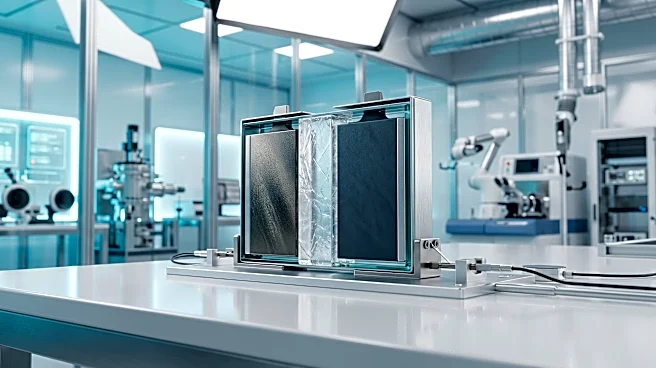
QuantumScape, a company specializing in solid-state battery technology, announced plans in October 2026 for a 100-megawatt-hour production line slated to begin in 2028. This development follows the company's unveiling of Osprey on November 11, 2026, an all-solid-state
battery platform utilizing a ceramic separator and a solid sulfide-containing cathode. QuantumScape reported that a test cell of the Osprey platform achieved an 80% charge from 10% in approximately five minutes. However, this rapid charging test was conducted at 80°C, not at typical room temperature. The company acknowledges that the technology still requires scaling beyond small test cells for broader application. This advancement is part of a larger trend in the battery industry, where companies like Toyota, Samsung, and Solid Power are heavily investing in solid-state battery research and development.
Why It's Important?
The advancements by QuantumScape in solid-state battery technology hold significant implications for the electric vehicle (EV) and energy storage sectors in the U.S. and globally. Solid-state batteries promise higher energy density, faster charging times, and improved safety compared to traditional lithium-ion batteries, which are nearing their performance and safety limits. The ability to charge an EV in minutes could address a major consumer concern regarding range anxiety and charging infrastructure, potentially accelerating EV adoption. Furthermore, the extended lifespan of solid-state batteries, projected to last 15-20 years compared to 5-10 years for current lithium-ion batteries, could reduce overall costs and environmental impact. While the 80°C test condition for rapid charging indicates that commercial viability at room temperature is still a hurdle, the progress demonstrates the potential for a transformative shift in battery technology, impacting manufacturing, transportation, and renewable energy integration.
What's Next?
QuantumScape's immediate next steps involve scaling their Osprey technology beyond small test cells and moving towards the planned 100-megawatt-hour production line by 2028. The company will need to address the challenges of manufacturing solid-state batteries at scale, which currently face issues with cost, material purity, and interface problems between solid layers. Further research and development will likely focus on optimizing performance at ambient temperatures and ensuring long-term durability under real-world conditions. The broader industry will be watching for continued progress in road tests and integration into commercial vehicles, similar to how Factorial Energy's cells have been integrated into Mercedes-Benz and Stellantis prototype vehicles. The competition from conventional battery technologies, such as BYD's second-generation Blade Battery, which also boasts rapid charging capabilities, will push all players to innovate further and bring cost-effective, high-performance solutions to market.
Beyond the Headlines
The pursuit of solid-state battery technology, exemplified by QuantumScape's Osprey platform, represents a deeper shift in energy chemistry that could have profound ethical and environmental implications. The potential for longer-lasting batteries could reduce waste and the demand for raw materials, contributing to a more sustainable future. However, the manufacturing process for solid-state batteries, which requires extremely pure materials and specific environmental controls, presents its own set of challenges, including potential environmental concerns related to certain sulfide electrolytes. The development of advanced diagnostic tools, akin to 'MRI for batteries,' highlights a growing trend in scientific research towards understanding and controlling complex material behaviors at a microscopic level. This could lead to breakthroughs not only in battery technology but also in other material science applications, fostering innovation across various industries and potentially redefining our approach to energy storage and consumption.