





What's Happening?
Companies are encountering persistent difficulties in matching available workforce skills with their specific operational requirements. Despite numerous job applications for vacant positions, many candidates lack the precise capabilities needed for job descriptions.
Conversely, many workers are losing jobs due to corporate downsizing, creating a paradox where unemployment exists alongside unmet corporate skill demands. This issue, termed 'skill mismatch,' is exacerbated by the rapid integration of technology into business operations, requiring employees to adapt to digital systems. Research indicates that skills beyond academic knowledge, such as communication, teamwork, critical thinking, and technological proficiency, are increasingly vital. This misalignment leads to slower task completion, increased errors, suboptimal output, and additional recruitment and training costs for companies.
Why It's Important?
The skill mismatch problem has significant implications for both corporate efficiency and individual career development. For businesses, it directly impacts productivity, innovation, and profitability, as a workforce lacking essential skills cannot effectively meet evolving operational demands. This can hinder a company's ability to compete in a rapidly changing market. For workers, it leads to job insecurity, stalled professional growth, and diminished confidence, contributing to broader societal challenges like unemployment and underemployment. The issue also highlights a disconnect between educational institutions and industry needs, suggesting a systemic gap in preparing the workforce for current and future job roles. Addressing this is crucial for maintaining a competitive economy and a skilled labor force.
What's Next?
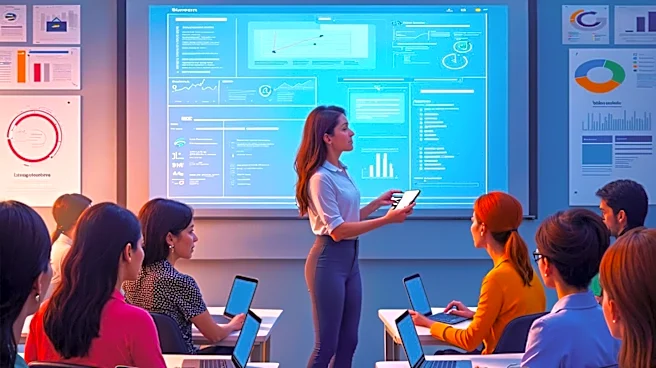
To address the skill mismatch, companies are advised to implement several strategic measures. First, regular audits of staffing needs are essential to prevent labor surpluses or shortages. Second, providing continuous training to existing employees, even simple sessions on technology or communication, can enhance capabilities. Third, establishing partnerships with schools and universities through internships and training programs can bridge the gap between education and industry requirements. Finally, companies need long-term employee management plans that offer opportunities for learning and adaptation as technology evolves, prioritizing employee development over immediate layoffs. These steps aim to foster a more adaptable and skilled workforce that can meet dynamic corporate demands.
Beyond the Headlines
The persistent skill mismatch points to deeper structural issues within the labor market and educational systems. It suggests that traditional educational pathways may not be adequately preparing individuals for the realities of modern workplaces, which increasingly demand specialized technical skills alongside soft skills. This situation could lead to a bifurcated labor market, where highly skilled workers are in demand while those with outdated skills struggle to find meaningful employment. Ethically, companies face the challenge of investing in reskilling their existing workforce versus seeking new talent, balancing loyalty with efficiency. Culturally, there may be a need for a shift towards lifelong learning, where continuous skill development is seen as a personal and professional imperative, driven by both individuals and employers.