





What's Happening?
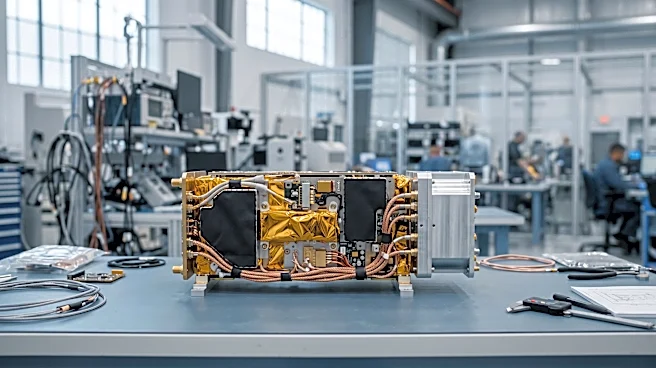
King Philippe of Belgium formally opened Europe's largest satellite manufacturing plant, the 20,000-square-meter Megafactory of Walloon company Aerospacelab, in Marcinelle near Charleroi. This facility, representing an investment of approximately €100
million, is designed to produce up to 500 satellites annually, making it the third-largest of its kind globally. The plant is set to play a crucial role in Europe's pursuit of greater strategic autonomy in space. Aerospacelab has secured a contract worth about €2.4 billion to build 264 of the 348 satellites for the European Union's IRIS² constellation, a secure communications network aimed at reducing Europe's dependence on non-European systems like Starlink. Production is expected to commence in early 2027. The company also announced its rebranding to Ectro from November 30, reflecting its transformation from a startup to a major industrial player.
Why It's Important?
This inauguration marks a significant step in Europe's ambition to achieve strategic autonomy in space, which has direct implications for the U.S. space industry and geopolitical landscape. The IRIS² constellation, designed to reduce reliance on non-European systems, signals a growing trend among allies to develop independent capabilities, potentially impacting U.S. dominance in satellite communications and related services. For U.S. companies, this could mean increased competition in the global satellite market and a potential shift in procurement preferences by European entities. The investment in such a large-scale manufacturing facility also highlights the strategic importance of space infrastructure for national security and economic competitiveness, a lesson that resonates with U.S. efforts to bolster its own space industrial base. The development of independent secure communication networks by allies could also influence intelligence sharing protocols and interoperability in future joint operations.
What's Next?
Production at the Megafactory is slated to begin in early 2027, focusing initially on the 264 satellites for the IRIS² constellation. The company, soon to be rebranded as Ectro, aims to increase its workforce from approximately 500 to 1,000 employees by the end of 2027. The successful deployment and operation of the IRIS² constellation will be a critical test of Europe's independent space capabilities. This development could also spur further investment in European space technology and manufacturing, potentially leading to more advanced and cost-effective solutions. For the U.S., monitoring the progress of IRIS² and other European space initiatives will be essential for understanding future collaboration opportunities and competitive dynamics in the global space arena.
Beyond the Headlines
The establishment of Europe's largest satellite factory and the development of the IRIS² constellation represent more than just industrial growth; they symbolize a broader geopolitical shift towards greater self-reliance among U.S. allies. This pursuit of 'strategic autonomy' in critical sectors like space reflects a desire to control essential infrastructure and reduce vulnerabilities in an increasingly complex global environment. While this could foster innovation and resilience within Europe, it also raises questions about the long-term implications for transatlantic cooperation and the potential for fragmentation in global space governance. The move away from reliance on systems like Starlink, a U.S.-based service, underscores a strategic imperative to secure critical communications, which could influence how nations approach data sovereignty and national security in the digital age. This development could also accelerate the commercialization of space, as more players enter the manufacturing and service provision sectors, driving down costs and expanding access to space-based capabilities.