





What's Happening?
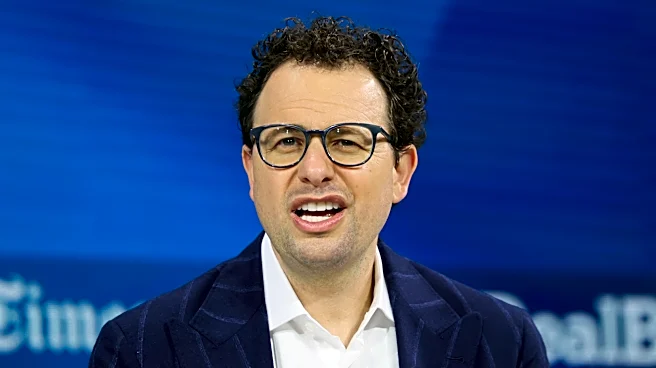
Jaan Tallinn, a co-founder of Skype and an early investor in Anthropic, has backed Sequent, a London-based startup, with a $2.2 million pre-seed investment. Sequent, founded by former Google DeepMind researchers, is developing a platform named Alan. This
platform utilizes artificial intelligence to generate mathematical proofs for software code safety and subsequently verifies these proofs using the HOL4 system. The capital infusion will primarily be allocated to cover compute costs associated with running AI models and to expand the team by hiring specialists in engineering, sales, and marketing. This investment highlights a continued focus on AI safety and verification within the technology sector, with Tallinn's involvement underscoring the importance of robust AI development.
Why It's Important?
Jaan Tallinn's investment in Sequent is significant due to his prominent role in the AI safety community and his track record of successful early-stage investments in influential AI companies like Anthropic. His backing lends credibility and visibility to Sequent's mission of enhancing software code safety through AI-driven mathematical proofs. This development is crucial for the broader technology industry, as the increasing complexity of software and AI systems necessitates more rigorous verification methods. Ensuring the safety and reliability of AI-generated code can prevent critical errors, security vulnerabilities, and unintended behaviors, which are paramount concerns as AI becomes more integrated into critical infrastructure and everyday applications. This investment could catalyze further interest and funding in AI safety and verification technologies, benefiting industries reliant on secure and dependable software.
What's Next?
Sequent plans to utilize the $2.2 million pre-seed funding to scale its operations, focusing on increasing its computational capacity for AI model execution and expanding its workforce. The company will be actively recruiting engineering, sales, and marketing professionals to further develop and commercialize its Alan platform. This expansion suggests that Sequent aims to bring its AI-powered software verification tools to a wider market, potentially collaborating with other tech companies or industries that prioritize software safety. The success of Alan could influence future standards and practices in software development, pushing for more automated and mathematically rigorous verification processes. Additionally, Jaan Tallinn's continued involvement may attract further investment and partnerships for Sequent, accelerating its growth and impact in the AI safety domain.
Beyond the Headlines
Jaan Tallinn's investment in Sequent reflects a growing trend and critical need within the AI landscape: the emphasis on verifiable AI and robust safety mechanisms. As AI systems become more autonomous and pervasive, the ability to mathematically prove the safety and correctness of their underlying code is not just a technical challenge but an ethical imperative. This development points towards a future where AI applications, especially in sensitive sectors like autonomous vehicles, healthcare, and finance, will require stringent formal verification. The broader implication is a shift in AI development paradigms, moving beyond empirical testing to include formal methods that guarantee certain properties of AI systems. This could lead to new regulatory frameworks and industry standards that mandate such verification, fundamentally altering how AI is designed, deployed, and trusted.