



What's Happening?
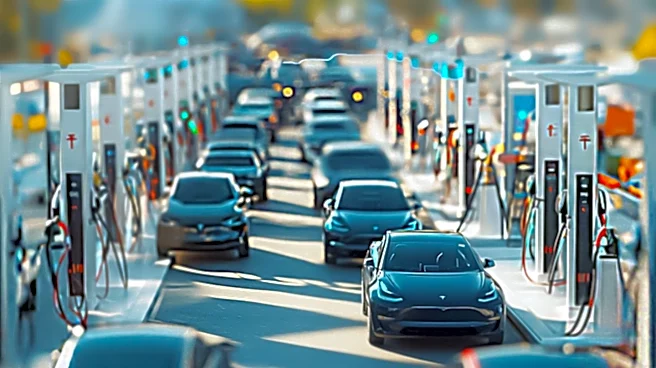
Tesla is developing a significant charging facility in Austin, Texas, at 405 E. St. Elmo Road, which is expected to play a crucial role in its upcoming Cybercab robotaxi service. The project is planned in two phases. The initial phase will include 48
V4 Supercharger posts. The second phase is notable for its provision for 80 wireless chargers, indicating Tesla's long-term vision for automated charging. This development coincides with Tesla's confirmation of a Cybercab launch event, speculated to occur in late August or early September in Austin. Tesla is offering current Robotaxi riders a chance to attend this event, with qualifying rides ending August 23 and winners announced on August 25. The site for the new charging hub is an existing logistics lot previously used by Tesla for transporter drop-offs and pickups, which the company appears to have acquired and is now converting into a Supercharger station.
Why It's Important?
This planned charging hub in Austin is a critical infrastructure development for Tesla, particularly as it prepares for the launch of its Cybercab robotaxi service. The inclusion of 80 wireless chargers in the second phase signals a significant technological advancement and a strategic move towards fully automated vehicle operations. Wireless charging eliminates the need for manual plugging, which is essential for a seamless robotaxi experience and could set a new standard for autonomous vehicle infrastructure. The location in Austin, where the Cybercab launch event is anticipated, reinforces the city's role as a key hub for Tesla's innovation and deployment. This investment in advanced charging technology could accelerate the adoption of robotaxis by addressing logistical challenges and improving operational efficiency. For the electric vehicle industry, this move by Tesla could spur further development and integration of wireless charging solutions, potentially influencing future urban planning and transportation systems. It also highlights Tesla's commitment to vertical integration, controlling both the vehicles and the necessary charging infrastructure.
What's Next?
The immediate next step is the anticipated Cybercab launch event, likely in late August or early September in Austin, where Tesla is expected to officially unveil the vehicle and its operational plans. The construction of the charging hub will proceed in phases, with the initial 48 V4 Supercharger posts becoming operational first, followed by the integration of the 80 wireless chargers. This phased approach allows Tesla to support its existing Model Y Robotaxi fleet and early Cybercabs while preparing for the full wireless charging capabilities. The success of the Cybercab launch and the efficiency of the new charging infrastructure will be crucial for Tesla's expansion of its robotaxi service. The company has already been producing Cybercabs at Gigafactory Texas, with sightings of large fleets in various U.S. locations, suggesting a rapid rollout could follow the Austin debut. The development of FSD v15, which the Cybercab is expected to run, will also be a key factor in the service's performance and scalability.
Beyond the Headlines
The development of a large-scale charging hub with wireless capabilities for robotaxis represents a significant step towards a future where urban transportation is largely autonomous and seamlessly integrated. This move by Tesla is not just about charging electric vehicles; it's about creating an ecosystem that supports a new paradigm of mobility. The shift to wireless charging could reduce urban clutter associated with charging stations and enhance the aesthetic and functional aspects of public spaces. However, it also raises questions about the standardization of wireless charging technology and potential compatibility issues with other EV manufacturers. Furthermore, the widespread deployment of robotaxis and their supporting infrastructure could have profound societal impacts, including changes in urban planning, employment in the transportation sector, and public perception of autonomous technology. The ethical and regulatory frameworks for such advanced systems will need to evolve rapidly to keep pace with technological advancements, ensuring safety, accessibility, and equitable access to these new services.