





What's Happening?
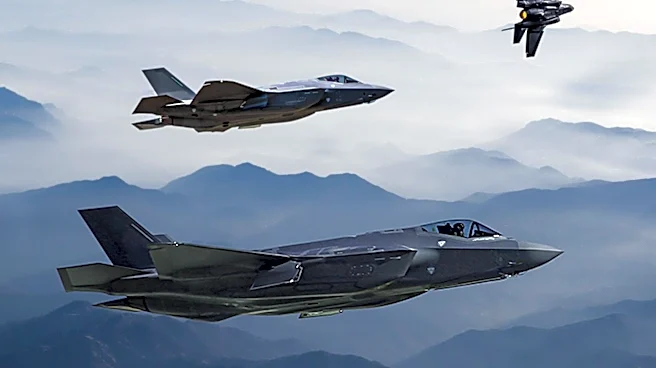
Lockheed Martin's share price has recently experienced a downturn, falling 3.37% over the past week and 6.40% over the last month. This decline occurs despite several positive developments for the company, including new awards related to the F-35 program,
a record third-quarter backlog, and a new cybersecurity partnership. Specifically, Lockheed Martin has teamed up with Nozomi Networks to develop automated cybersecurity and configuration compliance tools for defense networks, a collaboration tied to the F-35 offset program for Switzerland. The company is also moving munitions like PAC-3, THAAD, PrSM, and JATM onto seven-year framework agreements, aiming to significantly increase production and retain a larger share of cost savings from capacity investments, such as robotics in Camden. These investments are expected to support higher future revenue and structurally stronger net margins.
Why It's Important?
The recent cooling of Lockheed Martin's stock price, despite strong underlying business fundamentals and strategic partnerships, presents a complex picture for investors and the defense industry. The collaboration with Nozomi Networks highlights the increasing importance of cybersecurity in defense, particularly for advanced platforms like the F-35. This partnership could set a new standard for securing critical defense infrastructure and intellectual property. Furthermore, the long-term framework agreements for munitions production indicate a strategic shift towards greater efficiency and cost savings through automation and advanced manufacturing techniques. This could lead to more competitive pricing for defense products and potentially higher profit margins for Lockheed Martin, benefiting shareholders in the long run. However, the stock's recent performance suggests that market sentiment may be influenced by broader economic factors or specific investor concerns, even as the company strengthens its operational and technological capabilities.
What's Next?
The market will be closely watching Lockheed Martin's performance in the coming quarters to see if the recent stock cooling is a temporary blip or indicative of deeper concerns. The success of the new cybersecurity tools developed with Nozomi Networks and their integration into defense networks will be a key indicator of the partnership's impact. Additionally, the progress and efficiency gains from the seven-year framework agreements for munitions production, particularly the impact of robotics in Camden, will be crucial for realizing the projected higher revenues and net margins. Investors will also be monitoring for any potential risks, such as unforeseen charges from fixed-price or legacy programs, or new regulatory or tax issues that could affect the company's financial outlook. The company's ability to maintain its record backlog and secure further F-35 related awards will also be critical for its continued growth.
Beyond the Headlines
The strategic moves by Lockheed Martin, particularly in cybersecurity and advanced manufacturing, reflect a broader trend in the defense industry towards integrating cutting-edge technology to enhance both security and efficiency. The partnership with Nozomi Networks underscores the growing recognition that cyber threats are as critical as physical ones in modern warfare and defense. This collaboration could influence how other defense contractors approach cybersecurity, potentially leading to industry-wide adoption of more robust and automated solutions. Moreover, the emphasis on robotics and capacity investments for munitions production points to a future where defense manufacturing is highly automated and optimized, potentially reducing costs and increasing output. This could have long-term implications for supply chain resilience and national security, ensuring a steady and efficient supply of critical defense assets. The balance between technological advancement, market valuation, and geopolitical stability will continue to shape Lockheed Martin's trajectory.