


What's Happening?
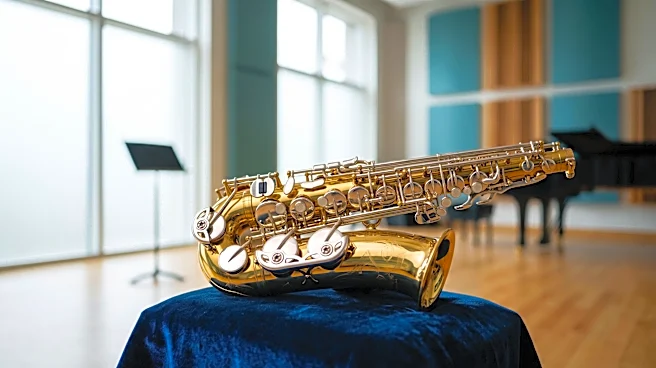
David Nabb, a music professor at the University of Nebraska at Kearney (UNK), has pioneered the development of a one-handed saxophone, enabling musicians with disabilities to play the instrument. Nabb's journey began after he suffered a stroke in 2000,
which paralyzed the left side of his body. Collaborating with Jeff Stelling, owner of Kearney-based Stelling Brass & Winds, Nabb helped create the 'toggle-key' mechanism, which allows a player's right hand to perform functions typically requiring both hands. This innovation has led to the establishment of the UNK One-Handed Woodwinds Program, which builds adaptive instruments and leases them to musicians with disabilities, aiming to remove barriers to musical participation. Nabb has performed globally with the adaptive instrument and was the first disabled musician to perform on a one-handed saxophone at the North American Saxophone Alliance Biennial Conference in 2023.
Why It's Important?
This development is crucial for promoting inclusivity and accessibility within the music community, particularly for individuals with physical disabilities. By providing adaptive instruments, the UNK One-Handed Woodwinds Program offers opportunities for disabled musicians to pursue their passion and professional aspirations, which might otherwise be impossible. This initiative challenges traditional perceptions of musical performance and instrument design, fostering innovation in assistive technology. The program's success, including a recent contract with the U.S. Department of Veterans Affairs to build a toggle-key saxophone for a veteran, underscores its growing recognition and potential to impact a wider population, enhancing the quality of life and artistic expression for many.
What's Next?
The UNK One-Handed Woodwinds Program is continuing its expansion, with plans to build a left-handed alto saxophone for musicians with disabilities affecting their right hand, a project estimated to take 2.5 years and cost approximately $25,000. Fundraising efforts are underway, supported by UNK students, the Nebraska Music Educators Association, and various donors and corporate contributions. The program's collaboration with the U.S. Department of Veterans Affairs signifies a significant step towards broader national adoption and support for adaptive instruments. Nabb's involvement in initiatives like the Cincinnati Adaptive Arts and Music Camp also indicates a future focus on making music accessible through affordable adaptive instruments, such as one-handed recorders.
Beyond the Headlines
The work of David Nabb and the UNK One-Handed Woodwinds Program extends beyond mere technical innovation; it addresses fundamental questions of human potential and artistic expression. By enabling individuals with disabilities to engage in music, the program fosters a sense of belonging, self-worth, and community. It highlights the ethical imperative to design inclusive technologies and environments that cater to diverse needs, challenging societal norms that often marginalize disabled individuals. This initiative could inspire similar adaptive solutions in other fields, promoting a more equitable and accessible society where physical limitations do not preclude participation in cultural and professional life. The long-term impact could be a paradigm shift in how disability is perceived within the arts and beyond.