





What's Happening?
Amazon has reached the No. 1 spot on the 2026 Fortune 500 list, ending Walmart’s 13-year reign, and also topped the 2026 Fortune Global 500 as the world’s largest company by revenue. This achievement comes despite founder Jeff Bezos's past prediction
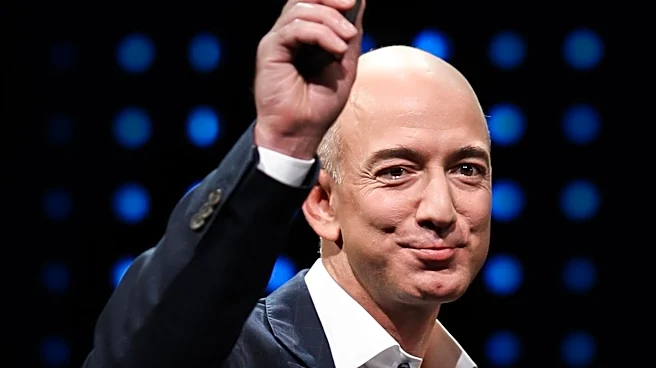
that Amazon would eventually fail and go bankrupt, stating in a 2018 all-hands meeting that "Amazon is not too big to fail." Bezos had suggested that large companies typically have lifespans of 30-plus years, not a hundred-plus. Amazon, which registered its domain 32 years ago, has now outlived this predicted window. The company's diverse operations include streaming, movie production, grocery stores, cloud computing (AWS), warehouse robotics, and home security cameras, alongside its core e-commerce business. General Motors, the only other Fortune 500 No. 1 to face bankruptcy, did so in 2009 but later re-emerged.
Why It's Important?
Amazon's ascent to the top of the Fortune 500 signifies a major shift in the U.S. corporate landscape, highlighting the dominance of technology and e-commerce over traditional retail and industrial sectors. This milestone underscores the company's aggressive expansion and diversification strategy, which has allowed it to integrate various aspects of consumer life, from entertainment to cloud infrastructure. The company's continued growth, even after Bezos's departure from the CEO role, demonstrates the resilience and adaptability of its business model. Its significant investments in areas like generative AI and data centers for Amazon Web Services indicate a forward-looking approach that could further solidify its market position. This success also challenges conventional wisdom about corporate longevity, as Amazon has not only survived but thrived beyond its founder's own pessimistic outlook, showcasing the potential for sustained innovation and customer focus to drive long-term success in the modern economy.
What's Next?
Under CEO Andy Jassy, Amazon plans substantial capital expenditures, with an estimated $220 billion this year, primarily directed towards data centers for Amazon Web Services and generative AI. This investment is an increase from the $200 billion forecast earlier in the year. Jassy has expressed ambitions for Amazon to potentially have two businesses—AWS and its retail segment—each reaching $1 trillion in annual revenue within the next five to ten years. This aggressive investment strategy suggests a continued focus on technological advancement and market expansion. The company's ability to maintain its customer-centric approach, as emphasized by Bezos, will be crucial in delaying the 'beginning of the end' and sustaining its growth trajectory. Future developments will likely involve further integration of AI into its services and continued competition in the cloud computing and e-commerce sectors.
Beyond the Headlines
Amazon's journey from an online bookstore to the world's largest company by revenue raises profound questions about corporate evolution and market power. The company's ability to consistently innovate and expand into new sectors, often disrupting existing industries, highlights the dynamic nature of the modern economy. The emphasis on customer obsession, as articulated by Jeff Bezos, serves as a case study in business philosophy, suggesting that a relentless focus on consumer needs can be a powerful antidote to corporate stagnation. However, this dominance also brings scrutiny regarding market concentration, labor practices, and data privacy. The company's sheer scale and influence mean that its strategic decisions have far-reaching implications for global commerce, technological development, and societal norms, making its trajectory a critical indicator for future economic trends and regulatory challenges.