






What's Happening?
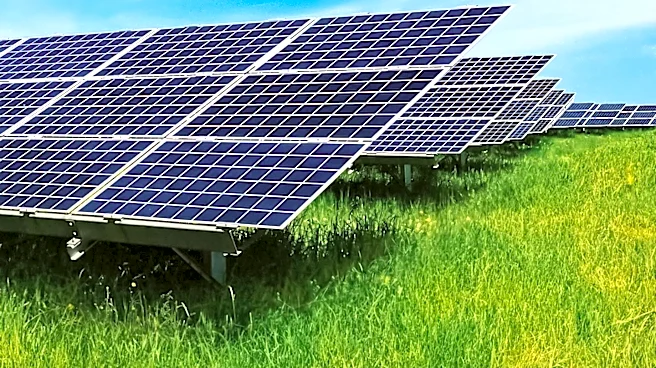
Solrite Energy, a Texas-based company, has introduced a new program in Illinois offering rooftop solar installations paired with a 60 kWh home battery for no upfront cost to qualifying homeowners in ComEd and Ameren Illinois territories. Under this 25-year
agreement, Solrite finances, owns, and maintains the system, while homeowners purchase the generated solar power at 12 cents per kWh, with potential annual increases of up to 2.9%. Homeowners will also continue to receive a utility bill for grid electricity and other applicable charges. The program leverages federal clean energy tax credits and Illinois Shines renewable energy credits, which Solrite retains due to its ownership of the equipment. This model, along with revenue from grid services, funds the zero-money-down option. The 60 kWh Duracell Power Center battery offers significantly more storage capacity than alternatives like the Tesla Powerwall 3, designed to power essential loads for days during outages. Illinois was chosen as a suitable market following its January 1, 2025, transition for new rooftop solar customers from full-retail net metering to supply-only credits, making exported solar power less valuable and increasing the need for on-site storage.
Why It's Important?
This initiative is significant for the U.S. renewable energy sector, particularly in states like Illinois, where changes in net metering policies have impacted the economic viability of traditional solar installations. By offering a no-money-down model and substantial battery storage, Solrite addresses the challenge of high upfront costs and the reduced value of exported solar energy. This approach could accelerate solar adoption among homeowners who might otherwise be deterred by initial investment or concerns about grid reliability. The large battery capacity not only provides energy independence during outages but also enables Solrite to aggregate these systems into a virtual power plant (VPP). This VPP can contribute to grid stability by supplying electricity or reducing demand during peak periods, acting as a distributed, grid-scale power plant. This model could serve as a blueprint for other states facing similar net metering adjustments, fostering a more resilient and decentralized energy infrastructure. The program also highlights the evolving business models in the clean energy industry, where companies are increasingly owning and managing assets to leverage incentives and provide comprehensive energy solutions.
What's Next?
Solrite's expansion into Illinois, its fifth market after Texas, California, Connecticut, and Massachusetts, suggests a broader trend of companies offering integrated solar and storage solutions to residential customers. The company has not yet disclosed its enrollment targets or anticipated VPP capacity for Illinois, but the success of this model could lead to its replication in other regions. Homeowners with existing rooftop solar systems in Illinois can also apply to add the 60 kWh battery without upfront payment, subject to compatibility review, indicating a potential for retrofitting existing solar infrastructure. The long-term impact will depend on the program's ability to attract a significant number of participants and effectively manage the aggregated VPP. As more states adjust their net metering policies, similar innovative financing and storage solutions are likely to emerge, further decentralizing the energy grid and empowering consumers with greater control over their energy consumption and resilience during outages. The performance of these large-scale battery deployments will also provide valuable data for future grid modernization efforts.
Beyond the Headlines
The shift in Illinois's net metering policy, which reduces the credit for exported solar power, underscores a broader challenge for the solar industry: how to maintain economic incentives for homeowners as grids evolve. Solrite's model, by retaining ownership and leveraging tax credits and grid services, represents a strategic adaptation to these policy changes. This approach transforms homeowners from mere energy producers into participants in a larger, more dynamic energy ecosystem. The concept of a virtual power plant, where distributed home batteries collectively support the grid, highlights a fundamental change in how electricity is managed and valued. This could lead to a more robust and flexible grid, less reliant on centralized power plants. However, it also raises questions about data privacy, grid control, and the long-term implications of third-party ownership of residential energy assets. The success of such programs will depend on transparent agreements, reliable technology, and continued regulatory support for distributed energy resources, potentially reshaping consumer relationships with utilities and energy providers.