




What's Happening?
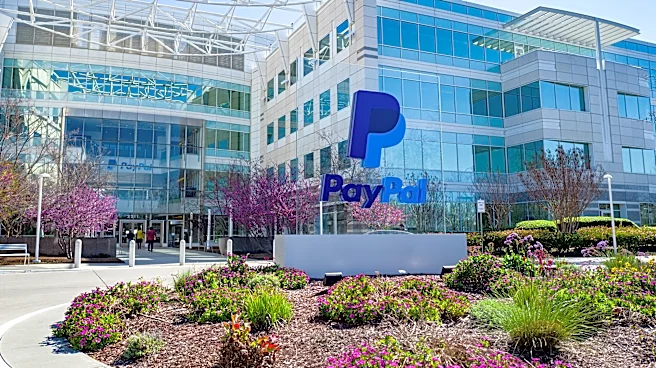
PayPal's management reported on October 27, 2026, that payment volume through its checkout button has experienced stagnant growth, ranging between 1% and 2% for four consecutive quarters. This minimal growth is attributed, in part, to the end of an EU
tax exemption known as de minimis, which created approximately 70 basis points of headwind for checkout volume growth. Despite this, there are some positive indicators, with U.S. checkout volume improving for the third quarter in a row and Germany showing stabilization. However, management anticipates the 1%-2% growth rate to persist through the fourth quarter of 2026, expecting European headwinds to continue. The company's overall revenue growth has slowed throughout 2026, falling from 7.2% in fiscal Q1 to 4.8% in Q2, and further to 2.0% in Q3, reaching $8.58 billion.
Why It's Important?
The sluggish growth of PayPal's core checkout button is a critical concern for the company, as it remains a significant part of its business despite the rapid expansion of newer services like Venmo and other financial offerings. While these newer segments are growing at double-digit rates and now constitute over 20% of transaction margin dollars, they have not yet been substantial enough to offset the overall slowdown. The impact of the EU's de minimis exemption ending highlights the sensitivity of e-commerce platforms to international trade policies and tax regulations, directly affecting merchant activity and transaction volumes. This situation puts pressure on PayPal to innovate and find new growth drivers for its foundational services, especially as investors are currently valuing the stock at a lower multiple compared to the broader market.
What's Next?
PayPal plans to invest further in transaction margin dollars and operating expenses in 2027, targeting non-GAAP EPS growth similar to 2026's projected $5.60. The company is underwriting its checkout spending with a two-to-three-year horizon, indicating that any significant repair or acceleration in checkout button growth is a long-term endeavor. This extended timeline means that Venmo and other financial services will need to continue their strong growth trajectory to lift PayPal's overall performance. Investors will be closely watching payment volume growth at the checkout button and transaction margin dollars when PayPal reports its next earnings, expected in February 2027, to assess the effectiveness of these strategic investments and the company's ability to navigate ongoing market challenges.
Beyond the Headlines
The challenges faced by PayPal's checkout button underscore a broader shift in the digital payments landscape, where traditional payment processing is increasingly commoditized, and value is moving towards integrated financial services and peer-to-peer platforms. The company's reliance on a multi-year plan to revitalize its core offering suggests a recognition of deep-seated market changes rather than temporary fluctuations. This scenario could lead to increased competition from fintech startups and established financial institutions that are rapidly expanding their digital offerings. Furthermore, the impact of international tax policies, such as the de minimis exemption, illustrates how regulatory changes can have far-reaching consequences for global technology companies, necessitating agile adaptation and strategic diversification to maintain market leadership.