





What's Happening?
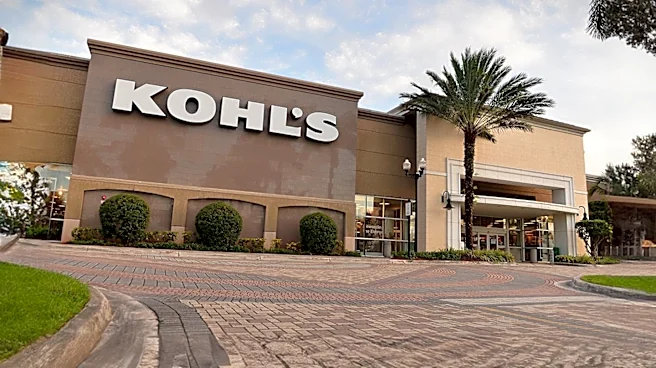
Kohl's has reported a significant turnaround in its third-quarter performance, with net sales increasing by 1.3% year over year to $3.5 billion and comparable sales rising by 1.2%. The company's net income saw a substantial jump, growing nearly 32 times
to $254 million, and its gross margin expanded by 145 basis points to 41%. This growth was observed across various merchandise categories, with particular strength noted in proprietary brands. However, the Sephora shop-in-shops within Kohl's stores experienced a nearly 2% decline in comparable sales. Despite this, Kohl's CEO Michael Bender defended the partnership with Sephora, emphasizing its role in attracting customers to Kohl's. Brick-and-mortar comparable sales increased by 2%, and Jefferies analysts noted a 4.4% improvement in traffic during October compared to September.
Why It's Important?
This Q3 performance is crucial for Kohl's as it signifies a potential turning point in its ongoing turnaround efforts. The growth in net sales and comparable sales, coupled with a substantial increase in net income and gross margin expansion, indicates improved operational efficiency and merchandising strategies. The focus on proprietary brands and sharper inventory management has contributed to better full-priced selling and profitability. While the decline in Sephora shop-in-shop sales presents a challenge, the overall positive results suggest that Kohl's is regaining market share among department stores, particularly by reducing reliance on promotions. However, the company still faces stiff competition from off-price retailers like TJX and big-box stores like Target, highlighting the need for sustained and more deeply rooted recovery.
What's Next?
Kohl's will likely continue to focus on its current strategies, including enhancing assortments, merchandising, and store operations, which CEO Michael Bender attributes to the recent success. The company will need to address the declining performance of its Sephora shop-in-shops, potentially by re-evaluating their integration or marketing within Kohl's stores, despite Bender's positive outlook on the partnership. Continued efforts to highlight proprietary brands and maintain sharp inventory management will be key to sustaining profitability and attracting value-seeking customers. The retailer will also need to monitor its market share against competitors outside the department store sector to ensure its recovery is comprehensive and not just relative to other department stores.
Beyond the Headlines
The mixed performance of Kohl's, particularly the contrast between overall growth and the decline in Sephora shop-in-shop sales, underscores the complex dynamics of the current retail landscape. It highlights the ongoing challenge for traditional department stores to adapt to evolving consumer preferences and intense competition from various retail formats. The success of Kohl's proprietary brands suggests a shift in consumer value perception, where private labels can drive sales and profitability. The situation also raises questions about the long-term efficacy of shop-in-shop models, especially when the partner brand's performance within the host store doesn't align with the host's overall growth. This could lead to a re-evaluation of such partnerships across the retail industry, focusing on deeper integration and mutual benefit.