







What's Happening?
Joby Aviation, Inc. (NYSE: JOBY) announced its Third Quarter 2026 financial results, revealing significant operational and financial progress. The company has raised its full-year 2026 revenue outlook by 15% to a range of $135 million to $140 million.
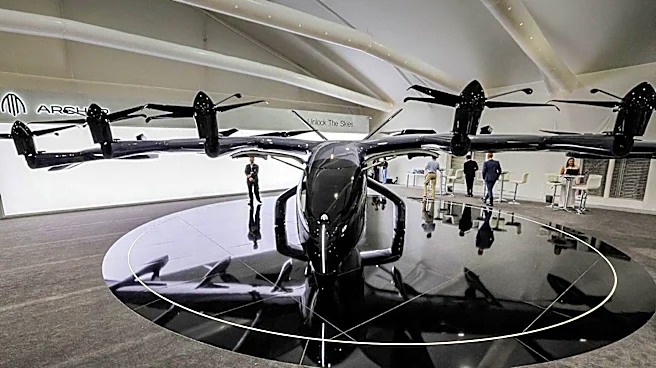
Key highlights include the completion of initial flights in Texas and Florida as part of the White House-backed eIPP program, aimed at accelerating the commercialization of air taxis. Joby also advanced its FAA type certification process, completing a wide range of 'for credit' testing in the fifth and final stage. Manufacturing output has substantially increased, with 17 aircraft currently in production. The company's urban air mobility business, Blade, experienced a record quarter, flying over 44,000 passengers and contributing $55 million in revenue. Additionally, Joby's J208 autonomous aircraft completed what is believed to be the first fully autonomous flight of a civilian aircraft across the United States, and its autonomy-focused contracts with the U.S. Air Force were expanded to nearly $37 million. Joby also plans to acquire Resonant Sciences, an EBITDA-positive defense technology company, to expand its defense business.
Why It's Important?
Joby Aviation's robust third-quarter performance and increased revenue outlook signal growing momentum in the nascent urban air mobility (UAM) sector within the U.S. The progress in FAA type certification is a critical step towards commercial passenger service, which could revolutionize short-distance travel and significantly impact urban planning and transportation infrastructure. The White House-backed eIPP program participation highlights government support for this emerging technology, indicating potential policy and regulatory frameworks favorable to UAM. The expansion of defense contracts and the acquisition of Resonant Sciences demonstrate Joby's strategic diversification and its potential to contribute to national security applications, beyond civilian use. The successful autonomous flight of the J208 aircraft marks a significant technological milestone, pushing the boundaries of aviation autonomy and potentially influencing future air traffic management systems. This progress could attract further investment and accelerate the development of the broader UAM ecosystem, creating new jobs and economic opportunities.
What's Next?
Joby Aviation will continue its efforts to achieve full FAA type certification, with further testing and regulatory approvals anticipated. The company's increased manufacturing output suggests a ramp-up towards commercial production, with more aircraft expected to enter service. The planned acquisition of Resonant Sciences will likely integrate new defense capabilities and expand Joby's market reach, potentially leading to new contracts and technological synergies. The ongoing eIPP program will provide valuable data and insights for the integration of air taxis into existing airspace, influencing future operational guidelines and infrastructure development. Stakeholders, including investors, regulatory bodies, and potential customers, will closely monitor Joby's progress in scaling operations, ensuring safety, and demonstrating the economic viability of its air taxi service. The company's focus on autonomy also suggests future advancements in automated flight systems, which could have broader implications for the aviation industry.
Beyond the Headlines
The advancements by Joby Aviation extend beyond mere financial and operational achievements; they represent a significant step towards a paradigm shift in transportation. The concept of urban air mobility raises profound questions about urban design, noise pollution, energy consumption, and accessibility. The successful autonomous flight of a civilian aircraft, while a technical triumph, also brings to the forefront ethical and regulatory challenges concerning autonomous systems in public transportation. The integration of UAM into existing transportation networks will require extensive collaboration between technology developers, city planners, and regulatory agencies. Furthermore, the environmental impact of electric vertical take-off and landing (eVTOL) aircraft, particularly in terms of energy demand and infrastructure, will be a critical consideration. The potential for reduced travel times and increased connectivity could reshape economic hubs and daily commutes, but equitable access to these services will be a key societal challenge.