





What's Happening?
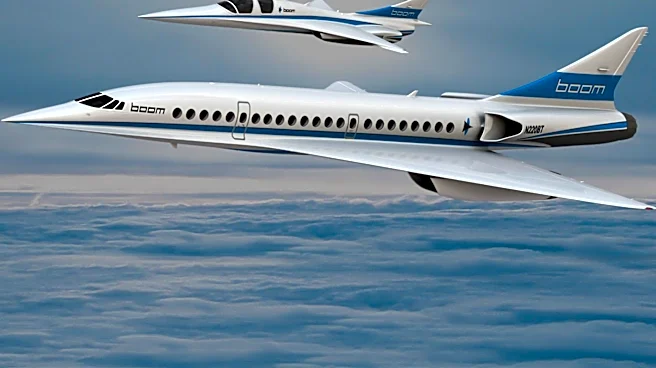
Boom Supersonic's XB-1 demonstrator aircraft conducted a 'Boomless Cruise' demonstration in January 2025, aiming to achieve supersonic flight over land without an audible sonic boom reaching the ground. The company reported success, with much of the initial
coverage suggesting a breakthrough for overland supersonic travel. However, the demonstration involved only two flights and six supersonic runs. The data and write-up were produced by Boom's own staff, without independent peer-reviewed validation, public raw datasets, or complete atmospheric measurements. The concept, known as Mach cutoff, relies on atmospheric conditions to bend shock waves upward. While the experiment was successful, it is considered preliminary and does not yet establish Boomless Cruise as a certified or reliably achievable method for commercial supersonic flight over land. The current U.S. regulation, 14 CFR 91.817, generally prohibits civil aircraft from exceeding Mach 1 over land, a rule in place since 1973.
Why It's Important?
The implications of Boom Supersonic's demonstration are significant for the future of commercial aviation and regulatory policy. If successfully implemented and certified, 'Boomless Cruise' could potentially open up new routes and reduce travel times across continents, fundamentally altering long-distance air travel. However, the lack of independent validation and comprehensive data raises questions about the technique's reliability and scalability for commercial operations. The Federal Aviation Administration (FAA) is currently working on a proposed rule to replace the speed-based ban with a noise-based standard, capping sonic-boom overpressure. The finalization of this rule, directed for June 6, 2027, is crucial. Until a new rule is finalized and an aircraft is certified against it, Boomless Cruise remains an unapproved procedure for passenger airlines, impacting potential investors, future passengers, and the aviation industry's strategic planning. The historical context of Operation Bongo II in 1964, which led to widespread complaints and property damage claims from sonic booms over Oklahoma City, underscores the public and regulatory sensitivity to this issue.
What's Next?
For Boom Supersonic's 'Boomless Cruise' to become a viable commercial reality, several critical steps must occur. First, the FAA needs to finalize its proposed noise-based standard for supersonic flight over land. This rule, which would replace the current speed-based ban, is expected by June 6, 2027. Second, an aircraft, such as Boom's planned Overture, must be certified against this new standard. This certification process will require extensive testing, independent data validation, and proof of reliability across various atmospheric conditions. Without a public date for this certification, the timeline for commercial supersonic overland travel remains uncertain. Stakeholders, including other aerospace companies, environmental groups, and the public, will closely monitor the FAA's rulemaking process and Boom's subsequent certification efforts. The industry will also need to address the operational challenges of continuously adjusting speed and altitude based on real-time atmospheric data to maintain 'boomless' conditions, a complex control problem that the initial demonstration did not fully address.
Beyond the Headlines
The pursuit of quiet supersonic flight touches upon deeper ethical, legal, and technological dimensions. Ethically, the balance between technological advancement and public nuisance, as evidenced by the historical backlash against sonic booms, remains a central concern. The legal framework is shifting from a simple speed limit to a more complex noise-based standard, requiring precise measurement and modeling of acoustic impacts. This shift could set precedents for how future aviation technologies are regulated based on their environmental and societal footprint. Technologically, the reliance on Mach cutoff highlights the intricate interplay between aircraft design, atmospheric science, and real-time data processing. The ability to predict and adapt to dynamic atmospheric conditions to prevent sonic booms represents a significant engineering challenge. Furthermore, the commercial viability of such flights will depend not only on regulatory approval but also on public acceptance and the economic feasibility of operating aircraft that require continuous atmospheric monitoring and adjustments. The long-term implications could include a redefinition of air travel efficiency and a renewed focus on sustainable aviation practices that minimize environmental and noise pollution.