





What's Happening?
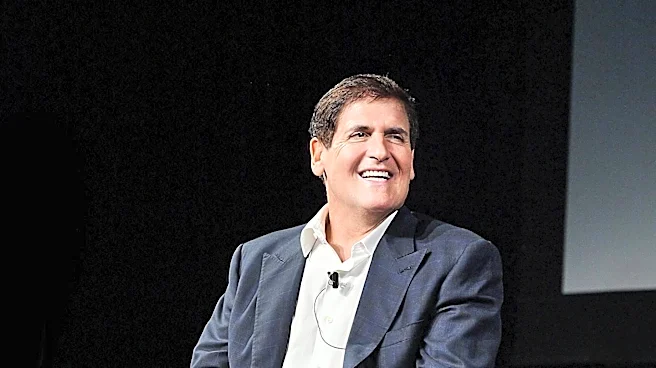
Billionaire entrepreneur Mark Cuban has clarified that a significant portion of a billionaire's net worth is typically tied up in illiquid assets, such as company stock and real estate, rather than readily available cash. This explanation comes in the context
of discussions around a proposed one-time 5% billionaire tax in California. Cuban, whose net worth exceeds $10 billion, stated that many billionaires might have as little as 5% of their wealth in liquid assets. He highlighted that entrepreneurs often reinvest profits back into their businesses, prioritizing growth over liquidity. Selling large amounts of company stock to generate cash could negatively impact the company's stock price. This situation contrasts sharply with the financial realities of many Americans who struggle with cash shortages for emergencies, often relying on high-interest loans.
Why It's Important?
This insight into the financial structure of billionaires is crucial for understanding wealth distribution and the practical implications of wealth taxation. It reveals that 'billionaire' status does not equate to having billions in accessible cash, which can complicate tax policies aimed at the ultra-wealthy. For instance, a wealth tax could force billionaires to sell company shares, potentially destabilizing markets or impacting the companies themselves. The distinction between liquid and illiquid assets also underscores a fundamental difference in financial security between the super-rich and average Americans. While billionaires can borrow against their illiquid assets, most cash-poor Americans must resort to credit cards or payday loans for unexpected expenses, highlighting a significant disparity in financial resilience and access to capital.
What's Next?
Discussions surrounding wealth taxes, such as the proposed 5% billionaire tax in California, will likely continue to face challenges in implementation due to the illiquid nature of much of billionaire wealth. Policymakers may need to consider alternative mechanisms for taxing wealth that account for these complexities, or face potential economic repercussions from forced asset sales. For the general public, understanding this financial dynamic could influence public perception of wealth and taxation, potentially leading to more nuanced debates about economic inequality. Financial advisors will continue to emphasize the importance of emergency funds for average Americans, contrasting with the investment strategies of the ultra-wealthy who prioritize long-term asset appreciation.
Beyond the Headlines
The revelation about billionaires' illiquidity sheds light on the sophisticated financial strategies employed by the ultra-wealthy, often involving teams of analysts and investment professionals. This contrasts with the financial realities of most individuals, who lack such resources. It also raises ethical questions about the fairness of tax systems that may inadvertently favor illiquid wealth over liquid assets, and how this contributes to broader societal inequalities. The concept of 'civil terrorism' in the context of financial markets, where large-scale asset sales could be seen as a form of economic disruption, could also emerge as a point of discussion. Ultimately, this understanding challenges conventional notions of wealth and prompts a deeper examination of how financial systems are structured and regulated.