


What's Happening?
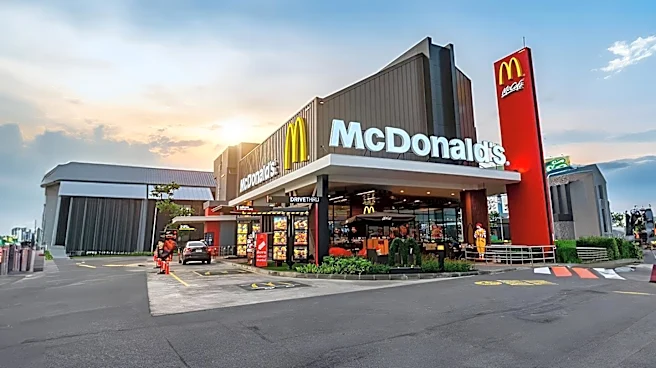
McDonald's has initiated testing of a new AI-powered ordering platform, ArchIQ, at five U.S. drive-thru locations. This system, developed in collaboration with Google and affectionately dubbed 'Archy,' is designed to handle the entire ordering process
from greeting customers to displaying orders and directing them to the pickup window. The company's CEO, Chris Kempczinski, stated in June 2026 that this initiative is part of McDonald's 'NEXT' strategy, aimed at enhancing growth and productivity by attracting more customers and improving unit economics. Archy has demonstrated over 90% accuracy in both English and Spanish during its testing phase, a figure McDonald's notes is comparable to human accuracy. This marks McDonald's second venture into AI-driven ordering, following a previous partnership with IBM in 2021 that did not proceed but affirmed the company's belief in voice ordering solutions for drive-thrus.
Why It's Important?
The deployment of AI in McDonald's drive-thrus signifies a significant shift in the fast-food industry's operational model, prioritizing efficiency and consistency. This move could set a new standard for customer service in quick-service restaurants, potentially reducing order errors and wait times. For McDonald's, successful implementation could lead to improved customer satisfaction and operational cost savings, which CEO Chris Kempczinski suggested could translate into better value for customers amidst inflation. The initiative also highlights the growing trend of automation in the service sector, potentially impacting labor dynamics within the industry. If successful, this technology could be widely adopted, influencing how consumers interact with fast-food brands and how these businesses manage their workforce and customer experience.
What's Next?
Currently, ArchIQ is in a testing phase at a limited number of U.S. locations. If the pilot program proves successful in terms of efficiency, accuracy, and customer acceptance, McDonald's may consider a broader rollout across its U.S. drive-thrus. The company's 'NEXT' strategy also includes broader initiatives such as menu upgrades, in-store technology improvements, and new store remodel prototypes, suggesting a comprehensive modernization effort. Other fast-food chains, including Wendy's, Yum! Brands (Taco Bell, Pizza Hut, KFC), Dairy Queen, Papa John's, White Castle, and Checkers/Rally's, are also exploring or implementing similar AI ordering technologies. This indicates a potential industry-wide shift towards automated ordering, which could lead to increased competition in technological innovation among fast-food giants.
Beyond the Headlines
The integration of AI like ArchIQ into everyday consumer interactions raises broader questions about the future of work and the customer experience. While proponents highlight increased efficiency and potential cost savings, there are underlying implications for employment in the service sector, as AI systems take over tasks traditionally performed by human employees. Furthermore, the reliance on AI for customer interactions could alter the human element of service, potentially leading to a more standardized, less personalized experience. Ethical considerations regarding data privacy and the potential for algorithmic bias in AI systems also become more pertinent as these technologies become more embedded in daily life. The success and widespread adoption of ArchIQ could accelerate the broader societal acceptance of AI in various customer-facing roles, prompting further discussions on the balance between technological advancement and human employment.