


What's Happening?
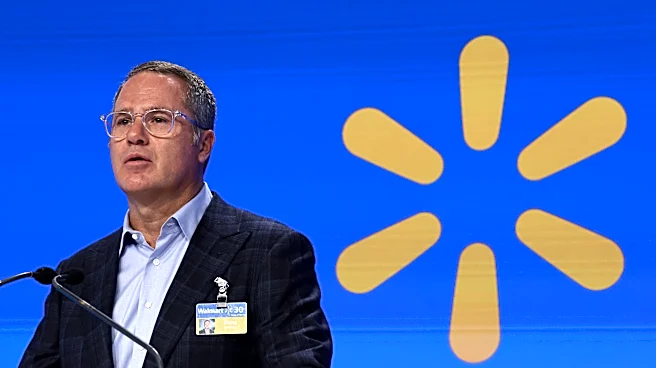
Walmart received nearly $2.9 billion in tariff refunds last quarter and has allocated the majority of these funds to implement over 11,000 price rollbacks across its U.S. stores. This strategic decision, as stated by CEO John Furner, is driven by a commitment
to customers who need lower prices, even as the company's U.S. comparable sales growth reached a six-year low. In contrast, Target, which received $994 million in tariff refunds during its second quarter, chose to retain these funds, resulting in a near doubling of its operating income to $2.6 billion. Walmart's approach initially led to a 10% drop in its shares on August 20, the sharpest decline since May 2022, though shares have since rebounded. The company's second-quarter revenue increased by 5.9% to $187.9 billion, with adjusted EPS of $0.81 surpassing the $0.74 consensus. Operating income rose by 28.8% to $9.38 billion, with tariff refunds contributing significantly to this growth.
Why It's Important?
Walmart's decision to invest heavily in price rollbacks using tariff refunds highlights a significant strategic divergence from competitors like Target and could have a substantial impact on the retail landscape. By prioritizing lower prices, Walmart aims to gain market share and customer loyalty, particularly during a period when U.S. comparable sales growth has slowed. This strategy could intensify price competition within the retail sector, potentially pressuring other retailers to follow suit or risk losing customers. For consumers, this means more affordable goods, which is particularly beneficial in an economic climate where many are seeking value. However, for investors, Walmart's approach signals a willingness to sacrifice immediate profit growth for long-term market positioning, which may lead to short-term stock volatility. The success of this strategy will depend on whether the increased customer traffic and market share gains translate into sustainable long-term profitability.
What's Next?
Walmart is scheduled to report its third-quarter results on November 19. Management has already indicated that significant profit growth is not expected for this quarter, largely due to the investment in price rollbacks. Investors will be closely watching the report for signs of improvement in Walmart U.S. comparable sales and operating income growth within the guided range of 2% to 4%. The company's ability to demonstrate that its strategy of using tariff refunds for price reductions is effectively driving customer traffic and market share will be crucial. Future audits and state-level checks regarding labor compliance will also be important, especially following a recent child labor settlement. The long-term success of this strategy will be evaluated by whether these investments lead to sustained market leadership and improved financial performance in subsequent quarters.