






What's Happening?
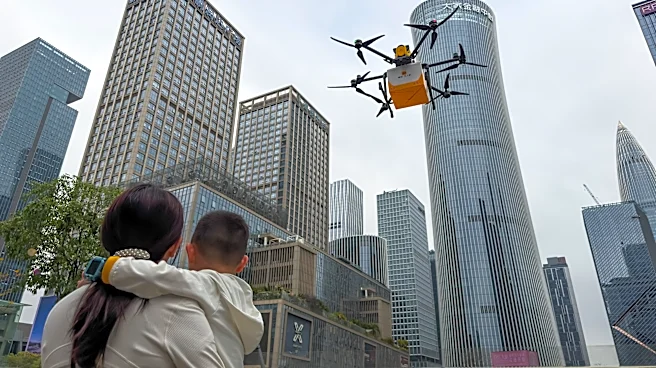
Walmart, in partnership with Wing, an Alphabet-owned drone delivery company, is set to introduce drone delivery services in Los Angeles by 2027. This initiative was highlighted by a recent demonstration flight in Los Angeles, showcasing the drones' capability
to deliver small packages. The companies initially announced their plans in January, aiming to expand ultra-fast delivery to 150 additional Walmart stores over the next year, reaching over 40 million Americans. By 2027, Walmart and Wing intend to establish a network of over 270 drone delivery locations across the U.S., spanning from Los Angeles to Miami. These drones are capable of flying up to 12 miles at speeds of up to 60 mph and can carry items such as hot coffee and other small packages. Drone deliveries are already operational in six other U.S. cities, including Dallas, Atlanta, Charlotte, and Orlando, with the partnership between Walmart and Wing commencing in 2023 with two Walmart Supercenters in Dallas. Other cities slated for future air services include St. Louis, Cincinnati, and Miami.
Why It's Important?
The expansion of drone delivery services by Walmart and Wing signifies a significant advancement in last-mile logistics and e-commerce fulfillment within the U.S. This move could reshape consumer expectations for delivery speed and convenience, particularly in densely populated urban areas like Los Angeles. For Walmart, it represents a strategic effort to enhance its competitive edge against other retailers and online marketplaces by offering ultra-fast delivery options. The broader adoption of drone technology for commercial delivery could also stimulate innovation in the aerospace and logistics sectors, creating new job opportunities and technological advancements. However, it also raises questions about urban airspace management, noise pollution, and potential regulatory challenges as drone traffic increases. The success of this initiative in Los Angeles could serve as a blueprint for wider deployment, influencing how goods are transported and delivered across the nation.
What's Next?
Following the recent demonstration, Walmart and Wing will continue to prepare for the full launch of drone delivery services in Los Angeles by 2027. This will likely involve further testing, infrastructure development, and securing necessary regulatory approvals for widespread operation in urban environments. The companies plan to scale their services to an additional 150 Walmart stores over the next year, aiming for a network of over 270 drone delivery locations by 2027. This expansion will extend to major cities like St. Louis, Cincinnati, and Miami. Competitors, such as DoorDash, which has also announced its drone program in California, will likely monitor Walmart and Wing's progress closely, potentially accelerating their own drone delivery initiatives. The coming years will see increased efforts in integrating drone delivery into existing logistics networks and addressing public concerns regarding safety and privacy.
Beyond the Headlines
The widespread adoption of drone delivery services, as spearheaded by Walmart and Wing, carries profound implications beyond mere convenience. It could fundamentally alter urban planning and infrastructure, potentially leading to designated drone landing zones in residential areas or specialized delivery hubs. Environmentally, while drones offer a potentially greener alternative to traditional delivery vehicles for short distances, the energy consumption and manufacturing footprint of large drone fleets will need careful consideration. Legally, the expansion will necessitate the development of comprehensive federal and local regulations governing drone flight paths, altitude restrictions, and liability in case of accidents. Culturally, the sight of drones regularly traversing residential skies could become commonplace, shifting public perception of autonomous technology and its integration into daily life. This technological shift could also exacerbate the digital divide, as access to such services might initially be concentrated in more affluent or technologically advanced areas.