


What's Happening?
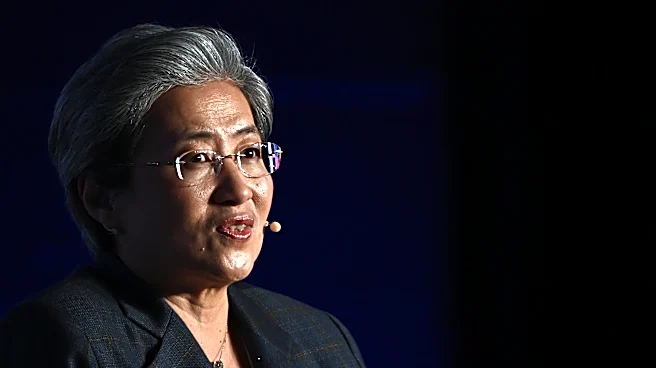
Lisa Su, CEO and Chair of AMD, has been recognized as Yahoo Finance's 2026 CEO of the Year. This accolade follows a period of significant growth and strategic advancement for AMD under her leadership. The company's stock has surged by 158% this year,
outperforming major competitors like Nvidia and Broadcom. AMD reported record third-quarter revenue of $13.38 billion, a 45% increase year-over-year, with its data center division doubling its revenue. Su has been instrumental in transforming AMD from a struggling chipmaker into a formidable competitor in the high-performance computing and artificial intelligence (AI) chip markets. Her strategy has focused on high-performance computing, rebooting AMD’s hardware business, and directly challenging Nvidia and Intel. Key product lines like Ryzen and EPYC chips have become central to laptops, servers, and data centers globally. AMD has also secured major partnerships with tech giants such as Microsoft, OpenAI, Meta, Anthropic, and Oracle, further solidifying its position in the AI infrastructure race.
Why It's Important?
Lisa Su's recognition as CEO of the Year highlights AMD's significant resurgence and its growing influence in the U.S. technology sector, particularly in the critical AI chip market. This shift is important because it introduces greater competition in a field previously dominated by a few key players, potentially leading to more innovation and diverse options for consumers and businesses. AMD's success under Su demonstrates that strategic leadership and a focus on high-performance computing can yield substantial returns, even against established industry giants. The company's expanding partnerships with major tech firms indicate a broader industry trend towards diversifying AI hardware suppliers, reducing reliance on a single vendor. This competitive landscape could drive down costs, improve performance, and accelerate the development of AI technologies across various U.S. industries, from cloud computing to enterprise solutions. The increased competition also fosters a more robust and resilient supply chain for essential computing components.
What's Next?
AMD is poised for continued growth, with Lisa Su outlining ambitious goals for 2027, including revenue growth exceeding 80% and a doubling of server and data center AI revenues. The company plans to leverage its MI450 GPUs and 6th generation EPYC Venice CPUs to power its Helios rack-scale AI system, which Microsoft began integrating into its Azure AI services in late 2026. A significant deal with Anthropic is also on the horizon, involving the purchase of up to two gigawatts of MI450 GPUs through the Helios platform starting in 2027, potentially worth tens of billions of dollars. AMD will also invest up to $5 billion in Anthropic. These developments suggest AMD will continue to aggressively expand its footprint in the AI infrastructure market, challenging Nvidia's dominance. The company's focus on building a separate AI ecosystem through its Instinct GPUs and EPYC processors indicates a long-term strategy to offer viable alternatives to existing solutions, potentially reshaping the competitive dynamics of the AI chip industry.
Beyond the Headlines
Lisa Su's leadership at AMD represents a significant narrative of corporate turnaround and strategic vision in the highly competitive semiconductor industry. Her journey, from her early career at IBM and Freescale Semiconductor to taking the helm of a struggling AMD, underscores the impact of focused leadership on technological innovation and market disruption. The rivalry between AMD and Nvidia, led by distant cousins Lisa Su and Jensen Huang, adds a unique personal dimension to the high-stakes competition in AI chip development. This dynamic highlights how individual leadership philosophies can shape corporate strategies and market outcomes. AMD's success in building its own AI ecosystem, rather than directly emulating Nvidia, also points to a broader industry trend where companies are seeking to differentiate through unique architectural approaches and software integrations. This could lead to a more diverse and specialized AI hardware landscape, fostering different types of AI applications and solutions in the future.