






What's Happening?
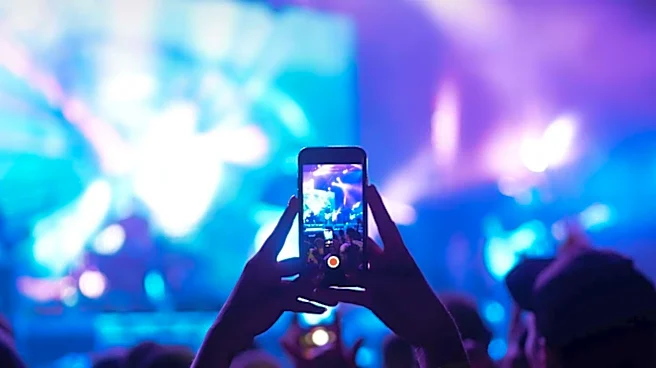
Research conducted on cell phone usage at concerts and sporting events indicates that individuals primarily record these experiences not for rewatching, but to share on social media and validate their attendance. This behavior, driven by a desire to 'prove'
a good time, contrasts with the initial assumption that recording aims to relive moments. The study also found that observing an experience without recording it leads to clearer memory retention. Recording events can result in 'cognitive offloading,' where individuals rely on their devices to store information, creating a barrier between documenting and fully experiencing the moment. This practice can negatively impact both the recorder's and others' concert experiences due to distractions and the constant presence of phones.
Why It's Important?
This research sheds light on the evolving social dynamics and psychological impacts of technology on live events in the U.S. The findings suggest a shift in how people value and engage with experiences, prioritizing external validation through social media over personal immersion and memory formation. For the entertainment industry, this could influence policies regarding phone use at venues, potentially leading to initiatives that encourage attendees to be more present. From a societal perspective, it highlights a broader issue of digital dependency and the constant need for external affirmation, impacting how individuals connect with their environment and each other. Understanding these motivations is crucial for addressing the balance between technology use and genuine experience in public settings.
What's Next?
The insights from this research could prompt concert organizers and venue managers to explore new strategies for managing cell phone use during live events. This might include designated 'phone-free' zones, educational campaigns about the benefits of being present, or even technological solutions that encourage less recording. Further research could delve into the long-term effects of cognitive offloading on memory and the psychological well-being of individuals constantly seeking social media validation. Additionally, there might be a growing movement among artists and performers to advocate for more immersive, phone-free concert experiences, potentially influencing audience behavior and expectations in the future. The goal would be to find a balance that allows for both capturing memories and fully engaging with the live performance.
Beyond the Headlines
The phenomenon of recording live events for social media rather than personal recollection points to deeper societal trends concerning identity, memory, and the digital self. It suggests that for many, an experience isn't fully realized until it's shared and validated online, blurring the lines between personal experience and public performance. This raises ethical questions about authenticity and the potential for a curated, rather than genuine, existence. The concept of 'cognitive offloading' also has broader implications for learning and information retention in an increasingly digital world, where external devices often serve as extensions of our memory. This shift could fundamentally alter how individuals perceive and interact with reality, emphasizing the importance of mindful technology use and fostering a culture that values presence over digital representation.