



What's Happening?
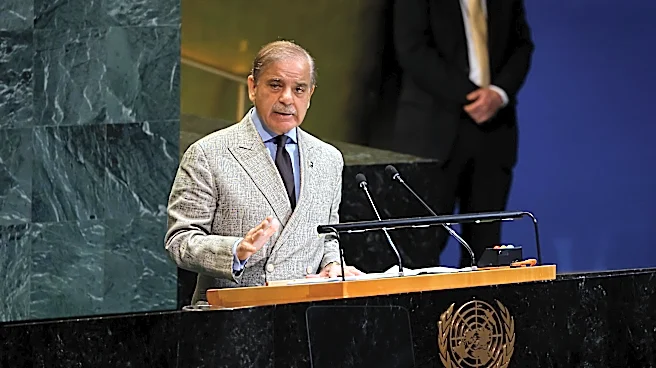
Prime Minister Shehbaz Sharif stated on Friday that Pakistan has the potential to become one of the world's major economies before 2050. Speaking at the Pakistan Minerals Investment Forum 2026, Sharif referenced a Goldman Sachs forecast predicting Pakistan could
be the world's sixth-largest economy by 2075. He emphasized the government's commitment to moving away from exporting raw minerals and instead utilizing them to support domestic industries. Sharif highlighted the Reko Diq project in Balochistan, one of the world's largest undeveloped copper and gold deposits, as a key initiative moving towards practical completion after being stalled for two decades. He also stressed the importance of protecting workers, assets, and supply routes, along with providing reliable infrastructure like electricity, water, and communications to attract investment. The Prime Minister pledged to expedite investment-related processes and eliminate administrative delays. Chief of Defence Forces and Army Chief Field Marshal Syed Asim Munir also spoke at the forum, assuring security for mining investments and emphasizing the goal of building an integrated value chain beyond raw material exports.
Why It's Important?
Prime Minister Sharif's optimistic outlook on Pakistan's economic future, particularly through the development of its mineral resources, signals a strategic shift towards value-added industries. This approach could significantly boost the nation's economy, create jobs, and reduce reliance on raw material exports, thereby improving its trade balance. The Reko Diq project, if successfully operationalized, could attract substantial foreign investment and establish Pakistan as a significant player in the global copper and gold markets. The commitment from both the civilian government and the military to ensure security and streamline investment processes is crucial for building investor confidence in a region often perceived as high-risk. This focus on economic transformation and industrial growth could lead to long-term prosperity and stability, impacting various sectors from manufacturing to infrastructure development.
What's Next?
The government's immediate next steps will likely involve implementing policies to facilitate investment in the minerals sector, including the establishment of the National Minerals Data Centre and the digitization of geological records. Efforts will be made to ensure cooperation between federal and provincial governments and to foster trust between mining companies and local communities. The progress of the Reko Diq project will be a key indicator of the success of this new economic strategy. Furthermore, the government will need to deliver on its promises of reliable infrastructure and security to attract and retain foreign investors. The long-term success of this vision will depend on sustained political stability, effective governance, and the ability to mitigate security risks in resource-rich areas.
Beyond the Headlines
The emphasis on developing mineral resources and moving towards value-added industries represents a broader economic philosophy aimed at self-sufficiency and industrialization. This strategy could have profound societal impacts, including job creation, skill development, and potentially improved living standards in mining regions. However, it also raises questions about environmental sustainability, equitable distribution of wealth, and the potential for social unrest if local communities do not perceive direct benefits. The military's involvement in assuring security for investments highlights the complex civil-military dynamics in Pakistan and the critical role of security in economic development. This initiative could also reshape Pakistan's geopolitical standing by making it a more significant player in global commodity markets.