


What's Happening?
The International Monetary Fund (IMF) has expressed skepticism regarding Mexico's ambition to rejoin the world's top 10 economies by 2030. In its latest World Economic Outlook, the IMF stated that this goal is unlikely to be achieved until at least 2031,
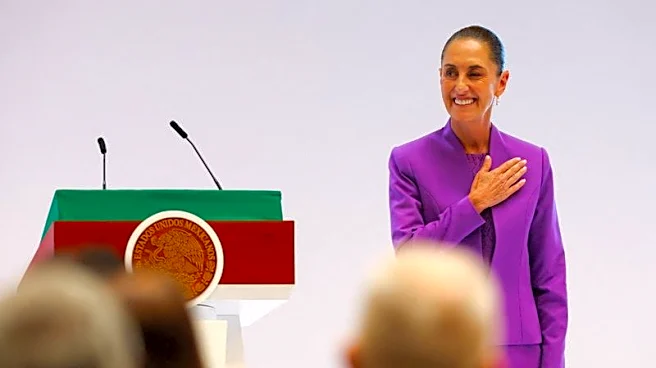
if at all. The IMF attributes this outlook primarily to underinvestment, projecting a maximum GDP growth rate of 2.2% during President Claudia Sheinbaum’s term, which concludes in 2030. This growth rate is deemed insufficient to elevate Mexico to the 10th position among global economies. Mexico had previously held a top 10 ranking from 1999 to 2004 but had fallen to 15th place by 2025. While it is expected to climb to 13th this year, surpassing Australia and Spain, and potentially reaching 12th by 2030 by displacing Russia, the IMF's projections indicate a slower trajectory than Mexico's stated objective. The IMF revised its economic growth forecasts for Mexico to 1.5% in 2026 and 1.8% in 2027, with a projected 2% in 2029, 2030, and 2031, which is below the average expected for Latin America and the Caribbean.
Why It's Important?
The IMF's assessment is significant as it highlights critical challenges for Mexico's economic development and its standing in the global economy. The identified issue of underinvestment suggests a need for substantial policy adjustments to stimulate economic growth. For the U.S., a robust and stable Mexican economy is crucial due to the extensive trade relationship under the USMCA and shared border interests. Slower economic growth in Mexico could impact cross-border trade, investment flows, and potentially lead to increased migration pressures. The IMF's recommendations, including increasing private investment, closing infrastructure gaps, reducing regulatory burdens, and strengthening trade integration, point to areas where U.S. businesses and policymakers might find opportunities for collaboration or influence. Furthermore, the emphasis on improving security, combating corruption, and reducing informality aligns with broader U.S. foreign policy goals in the region, as these factors are often linked to stability and economic prosperity. The report also underscores the importance of governance issues, such as public insecurity and political uncertainty, which are concerns for any foreign entity considering investment in Mexico.
What's Next?
To improve its economic trajectory, the IMF recommends that Mexico prioritize increasing private investment, addressing infrastructure deficiencies, and streamlining regulatory processes. The report also stresses the importance of enhancing security, combating corruption, and formalizing its economy. These recommendations suggest that the Mexican government, under President Sheinbaum, will need to implement policies that foster a more attractive environment for both domestic and foreign investment. Potential reactions from major stakeholders could include increased pressure on the Mexican government from international financial institutions and foreign investors to enact these reforms. Businesses, particularly those in the U.S. with operations or interests in Mexico, will likely monitor the government's response to these challenges, as their investment decisions will be influenced by the perceived stability and growth potential of the Mexican economy. The ongoing USMCA negotiations and the potential for U.S. tariffs also remain a critical factor, as uncertainty in these areas could further hinder new productive projects and impact Mexico's economic outlook.
Beyond the Headlines
The IMF's report delves deeper than mere economic statistics, touching upon fundamental governance issues that underpin Mexico's economic performance. The mention of public insecurity, lack of rule of law, internal political uncertainty, and corruption as major hindrances to growth highlights systemic challenges. These issues have broader societal implications, affecting not only economic development but also social cohesion and public trust. The long-term shift required involves a comprehensive approach to institutional reform and strengthening democratic governance. For the U.S., these underlying issues in Mexico have direct implications for border security, drug trafficking, and regional stability. Addressing these deep-seated problems would require sustained political will and potentially international cooperation. The report implicitly suggests that economic growth is not solely a matter of fiscal or monetary policy but is inextricably linked to the quality of institutions and the overall societal environment. The ethical dimension of combating corruption and ensuring the rule of law is paramount for sustainable development and for fostering a fair and equitable society.