





What's Happening?
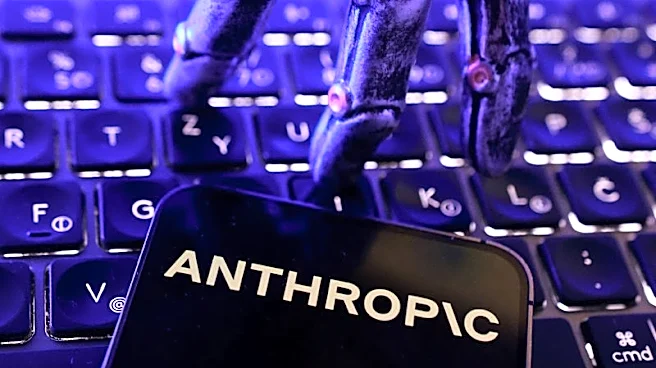
Several prominent artificial intelligence platforms, including OpenAI's ChatGPT, Anthropic's Claude, and X's Grok, are experiencing widespread outages. User reports on DownDetector and confirmed statuses on their respective dashboards indicate that these
services are currently unavailable. While AI outages are not uncommon, the simultaneous disruption of multiple major platforms is notable. Cursor, an AI agent, has also confirmed an outage, attributing it to the issues with Grok and Claude. Google's Gemini, another significant AI platform, appears to be unaffected, despite a temporary spike in user reports that Google has not confirmed as an official outage. The underlying cause of these widespread disruptions may be linked to Microsoft Azure, a cloud services provider that all three affected platforms rely on, which is also reporting a surge in outage reports.
Why It's Important?
The simultaneous outage of major AI platforms like ChatGPT, Claude, and Grok underscores the increasing reliance on these technologies across various sectors and the potential vulnerabilities within the cloud infrastructure that supports them. Businesses, researchers, and individual users who depend on these AI services for tasks ranging from content generation and data analysis to customer support and software development are directly impacted, leading to productivity losses and operational disruptions. This event highlights the interconnectedness of the digital ecosystem, where a single point of failure, such as a major cloud provider like Microsoft Azure, can trigger cascading effects across multiple critical services. The incident also raises questions about the resilience and redundancy of AI infrastructure, emphasizing the need for robust contingency plans and diversified cloud strategies to mitigate the risks associated with such widespread service interruptions.
What's Next?
As services begin to recover, the immediate focus will be on fully restoring functionality across all affected platforms. OpenAI has indicated that a fix has been applied and services are recovering, while Claude reports most models are back online, with the exception of Opus 4.8 and Opus 5. Grok's status still indicates an outage. Following the restoration, investigations will likely be conducted by OpenAI, Anthropic, X, and potentially Microsoft Azure to pinpoint the exact cause of the outage and implement measures to prevent future occurrences. This could involve strengthening infrastructure, enhancing monitoring systems, and improving disaster recovery protocols. Users will be closely monitoring the stability and reliability of these services, and some organizations may re-evaluate their reliance on single cloud providers or explore multi-cloud strategies to enhance resilience against similar disruptions in the future.
Beyond the Headlines
This widespread AI outage reveals a deeper systemic vulnerability in the rapidly evolving AI landscape. The concentration of critical AI services on a few major cloud providers, such as Microsoft Azure, creates a single point of failure that could have far-reaching economic and societal consequences. Beyond immediate productivity losses, prolonged or frequent outages could erode user trust in AI technologies and their underlying infrastructure. This incident may accelerate discussions around decentralization in AI development and deployment, encouraging the exploration of alternative hosting solutions or distributed AI architectures. Furthermore, it highlights the critical importance of cybersecurity and infrastructure resilience in an increasingly AI-driven world, prompting a re-evaluation of regulatory frameworks and industry best practices to ensure the stability and reliability of these essential digital tools.