

What's Happening?
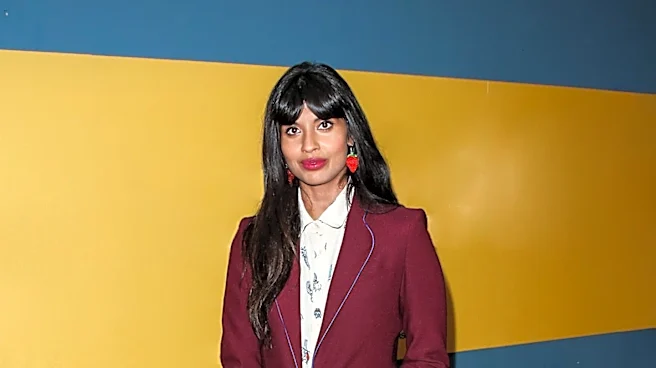
Actress Jameela Jamil has publicly criticized Botox and other injectables, calling them a 'prison' for women. In a powerful Instagram post, Jamil expressed her dismay over the increasing prevalence of expressionless faces in media, stating she misses
'faces that move' and women frowning and laughing naturally. She argued that women should not be taking health risks to conform to beauty standards she believes are imposed by men. Jamil also voiced concerns that the widespread use of injectables could make it easier for women to be replaced by artificial intelligence on screen and online, as motionless, uniform faces are simpler to replicate. Her comments echo sentiments from director Olivia Wilde, who also noted the difficulty in finding actresses who can still move their faces naturally.
Why It's Important?
Jameela Jamil's strong stance against Botox highlights a growing debate within the entertainment industry and broader society about beauty standards, aging, and the impact of cosmetic procedures. Her argument that injectables are a 'prison' for women challenges the narrative that these procedures are solely about personal choice and empowerment, suggesting instead that they are driven by external pressures and potentially harmful societal expectations. The concern about AI replacement adds a new, technological dimension to the discussion, suggesting that current beauty trends could inadvertently contribute to job insecurity for women in visual media. This critique is significant as it comes from a public figure, potentially influencing public perception and encouraging a more critical examination of the beauty industry's influence.
What's Next?
Jameela Jamil's comments are likely to fuel further discussion and debate among celebrities, industry professionals, and the public regarding cosmetic procedures and their implications. Her call for women to embrace natural expressions may encourage some to reconsider or delay cosmetic interventions. The discussion around AI replacement could prompt industry leaders and actors' unions to consider the long-term effects of current beauty trends on employment in film and television. This conversation might also lead to increased advocacy for more diverse and natural representations of aging and beauty in media, potentially influencing casting decisions and the types of roles available for actresses who choose not to use injectables. The beauty industry may also face pressure to innovate with less 'aggressive' treatments, as suggested by Olivia Wilde.
Beyond the Headlines
Jameela Jamil's critique of Botox extends beyond mere aesthetic preference, touching upon deeper ethical and cultural implications. Her assertion that injectables are a 'ploy' for AI replacement raises questions about the future of human authenticity in a digitally evolving world. It suggests a potential dehumanizing effect of uniform beauty standards, where individuality and natural expression are sacrificed for a standardized, easily replicable image. This perspective invites a broader conversation about the societal value placed on youth and an unchanging appearance, and how these values might inadvertently pave the way for technological displacement. It also highlights the ongoing struggle for women to define beauty on their own terms, free from external pressures and the subtle influences of emerging technologies.