



What's Happening?
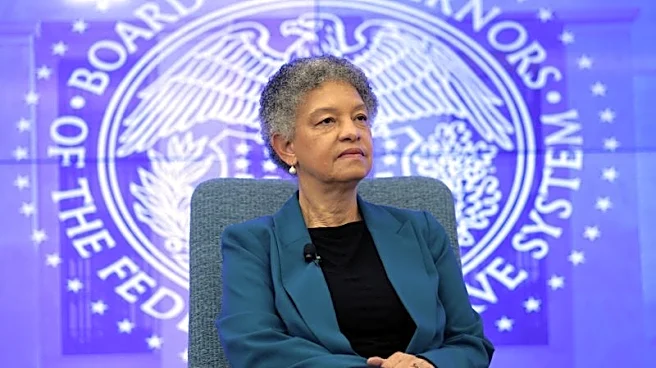
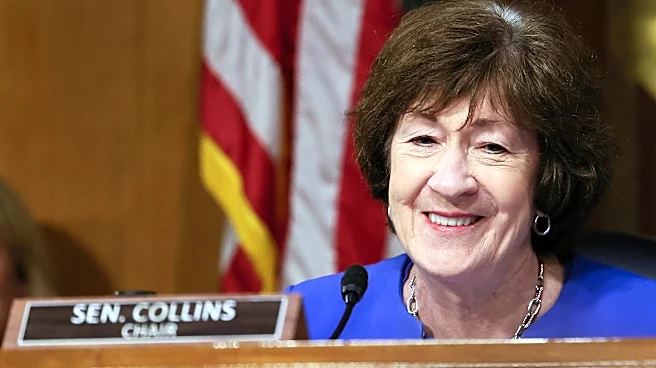
Federal Reserve Bank of Boston President Susan Collins stated on Saturday that she supports a steady pace of modest interest rate increases. Collins believes this approach is best suited for managing current economic uncertainties. Speaking at a conference
on housing issues in Boston, she emphasized that a 'steady, gradual path seems appropriate' for monetary policy adjustments, while remaining open-minded to evolving economic data. Collins noted that economic risks are 'two-sided,' with persistent high inflation that is broadening across the economy, alongside a stable job market that has potential for acceleration. She also acknowledged the ongoing risk of new economic shocks and the possibility that the recent rise in medium to longer-term interest rates could weigh more heavily on demand than currently anticipated. These factors, she argued, support a measured approach rather than a more aggressive pace of rate hikes to combat inflation, which has exceeded the Fed's 2% target for over five years.
Why It's Important?
President Collins's remarks provide insight into the Federal Reserve's cautious approach to monetary policy, highlighting the delicate balance between controlling inflation and avoiding excessive economic contraction. Her preference for gradual rate hikes suggests a desire to allow the economy sufficient time to adjust to increased borrowing costs, thereby mitigating potential negative impacts on growth and employment. This stance is particularly significant given that the Fed last raised rates in September and is widely expected to implement another quarter-point increase at its December 8-9 meeting, followed by another in January. While most Fed officials have favored steady, small increases, recent price data and comments from some governors have hinted at a potential desire for a larger increase. Collins's perspective underscores the internal debate within the Fed regarding the optimal pace of tightening, emphasizing risk management in a complex economic environment where inflation remains high but growth prospects are also a concern.
What's Next?
The Federal Reserve is widely anticipated to raise its benchmark interest rate by a quarter percentage point at its December 8-9 monetary policy meeting, moving the target range from 3.75%-4% to 4%-4.25%. Another increase is expected in January. While President Collins supports a gradual approach, she clarified that this 'doesn't necessarily mean a particular cadence,' indicating flexibility based on incoming data. She also noted that recent price data and a stronger labor market suggest that the path of policy rates over the next year might be slightly higher than she had previously anticipated. The Fed will continue to monitor inflation trends, labor market conditions, and broader economic indicators to determine the appropriate trajectory for interest rates. The ongoing debate within the Fed about the pace and magnitude of future hikes will be influenced by these data points, as policymakers strive to achieve price stability while supporting sustainable economic growth.
Beyond the Headlines
The Federal Reserve's strategy of gradual rate hikes reflects a broader challenge in modern monetary policy: navigating an economy with persistent inflation alongside potential vulnerabilities. The 'two-sided risks' highlighted by President Collins—high inflation versus potential demand suppression from rising rates—underscore the complexity. This approach aims to avoid both over-tightening, which could trigger a recession, and under-tightening, which could allow inflation to become entrenched. The long-term implications involve not only the cost of borrowing for consumers and businesses but also the stability of financial markets and the overall health of the U.S. economy. The Fed's careful calibration of rate increases is a response to an environment where traditional economic models may be less predictive due to global supply chain issues, geopolitical events, and evolving labor market dynamics. The success of this gradual strategy will depend on its ability to bring inflation back to target without causing undue economic hardship, a balance that remains a central focus for policymakers.