

What's Happening?
Patrick Ryan is referenced in an article discussing the 1991 Philadelphia Eagles defense, which is lauded as one of the best in NFL history. During that season, in the absence of injured quarterback Randall Cunningham, Jim McMahon, Jeff Kemp, Pat Ryan,
and Brad Goebel all served as the team's starting quarterback at various points. Despite the instability at the quarterback position and a lack of offensive production—no running back rushed for over 450 yards and no skill-position player exceeded 950 receiving yards—the Eagles managed a 10-6 record. This performance is attributed to the exceptional dominance of their defense, which was coached by defensive coordinator Bud Carson and assembled by Buddy Ryan. The 1991 unit led the NFL in rushing defense and passing defense, ranked first in sacks, first in completion percentage allowed (44.7%), third in interceptions, and fifth in points allowed.
Why It's Important?
The mention of Patrick Ryan highlights a significant period in NFL history, particularly for the Philadelphia Eagles franchise, where defensive prowess single-handedly carried a team to a winning record despite offensive struggles. This era serves as a benchmark for defensive excellence in the league, demonstrating how a dominant defense can compensate for deficiencies in other areas of the team. For current and future NFL teams, this historical context underscores the strategic value of investing in and developing a top-tier defense. It also provides a comparative framework for evaluating contemporary defensive units, such as the Eagles' 2024 and 2025 defenses under Vic Fangio, against a legendary standard. The 1991 Eagles' success, driven by their defense, illustrates a model where defensive strength can be the primary determinant of a team's competitiveness, influencing team building philosophies and resource allocation in professional football.
What's Next?
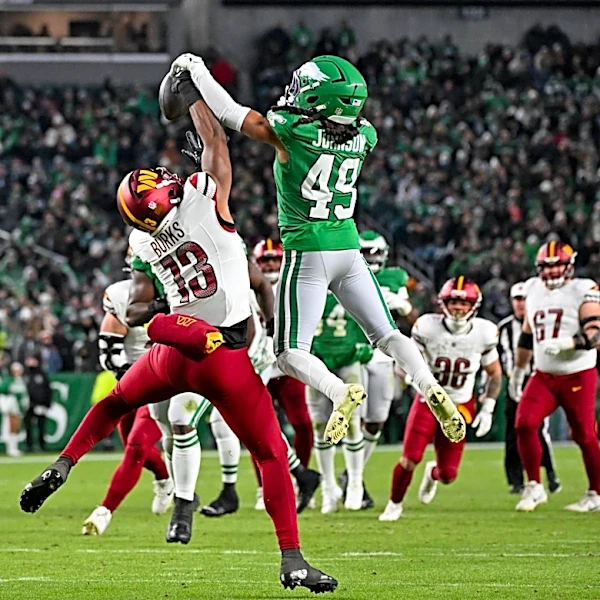
While the article primarily focuses on historical context, it draws comparisons to the Philadelphia Eagles' current defensive capabilities, particularly under defensive coordinator Vic Fangio. The discussion implicitly sets a high bar for the Eagles' upcoming seasons, suggesting that while the 2026 defense may not reach the 'mythological' status of the 1991 unit, it is expected to be elite. The article anticipates that the 2026 Eagles' defense, with new talent and established players, will continue to be a strength, potentially alleviating pressure on the offense. The ongoing evaluation of the team's defensive performance against historical benchmarks will likely continue to be a point of discussion among analysts and fans, especially as the team navigates potential offensive adjustments and new coaching staff.
Beyond the Headlines
The narrative surrounding the 1991 Eagles defense, and by extension, the role of quarterbacks like Patrick Ryan during that period, delves into the broader philosophical debate within football: the relative importance of offense versus defense. This historical example illustrates a rare instance where defensive dominance was so profound that it overshadowed significant offensive shortcomings, allowing the team to remain competitive. It challenges the modern NFL's increasing emphasis on high-scoring offenses and quarterback play, reminding stakeholders that a fundamentally strong defense can still be the backbone of a successful team. The 'mythological' status of the 1991 unit also speaks to the enduring legacy of certain teams and players, shaping fan expectations and contributing to the rich tapestry of NFL history and lore.