
What's Happening?
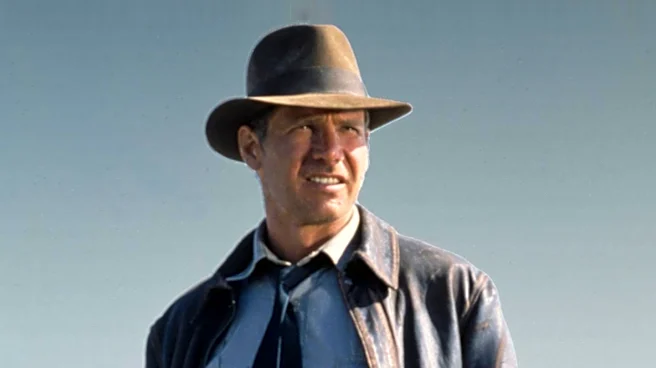
In 1994, actor Harrison Ford explicitly stated his unwillingness to return for a sequel to his successful 1993 film, 'The Fugitive.' Despite the movie's critical and commercial success, grossing nearly $370 million and receiving seven Academy Award nominations,
Ford believed the story of his character, Richard Kimble, was concluded. He reportedly rejected multiple screenplay drafts commissioned by Warner Bros. for a follow-up. Ford's stance was that he saw "absolutely no way" he could be part of a sequel that would be interesting to him and logically proceed from the original's ending. Consequently, the studio proceeded with a sequel, 'U.S. Marshals,' released in March 1998, which instead focused on Tommy Lee Jones' Oscar-winning character, Sam Gerard, from the first film. This decision resulted in a film that earned significantly less than its predecessor.
Why It's Important?
This event highlights the significant influence an actor's decision can have on the trajectory of a film franchise and its commercial success. Harrison Ford's refusal to reprise his role in 'The Fugitive' sequel demonstrates an actor's power to shape creative direction, even against a studio's financial interests. The subsequent underperformance of 'U.S. Marshals' without Ford underscores the value of a lead actor's star power and connection with an audience, particularly in established roles. For studios, it illustrates the risk of proceeding with a sequel when a key cast member is unwilling to return, potentially leading to diminished box office returns and critical reception. This case serves as a historical example within the film industry of how creative integrity, from an actor's perspective, can clash with commercial ambitions, impacting both artistic output and financial outcomes.
What's Next?
While this event occurred in the past, its implications continue to resonate in the film industry's approach to sequels and franchise management. Studios today often face similar challenges when attempting to revive or extend popular film series. The precedent set by Ford's decision and the subsequent outcome of 'U.S. Marshals' suggests that future decisions regarding actor involvement in sequels will likely continue to be heavily weighed. This includes considerations of an actor's perceived necessity for a franchise's success, the potential for recasting, or the development of spin-offs focusing on other characters. The ongoing trend of expanding cinematic universes and creating numerous sequels means that the balance between creative vision, actor commitment, and commercial viability remains a critical factor for studios and filmmakers.
Beyond the Headlines
The narrative surrounding Harrison Ford's refusal to return for 'The Fugitive' sequel delves into deeper themes of artistic control versus commercial pressure in Hollywood. It raises questions about the ownership of a character once it has been brought to life by a particular actor and the ethical considerations for studios in continuing a story without its original lead. The decision to proceed with 'U.S. Marshals' without Ford, and its subsequent reception, also speaks to the audience's attachment to specific actors in iconic roles. This situation underscores the complex interplay between an actor's legacy, a character's identity, and the financial machinery of the film industry. It highlights how, in some instances, the absence of a key performer can fundamentally alter the perceived authenticity and appeal of a cinematic continuation, impacting its cultural footprint and long-term viability.