





What's Happening?
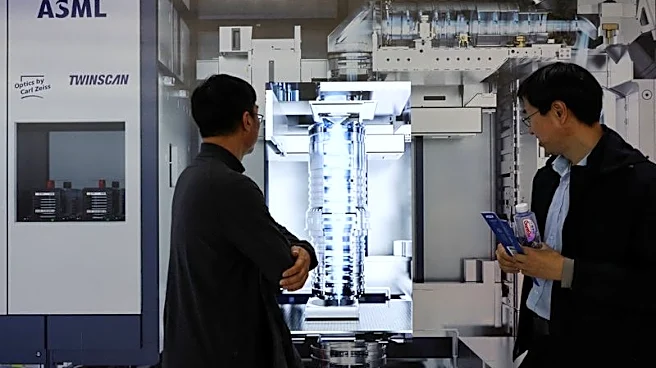
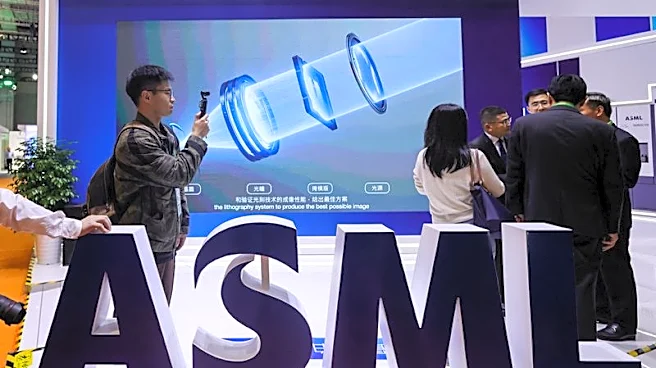
Christophe Fouquet, CEO of ASML, a Dutch company specializing in lithography machines crucial for advanced chip production, has voiced concerns that a complete ban on selling chipmaking tools to China would be counterproductive. Fouquet stated in an interview
with Semafor that ASML has maintained a near 100% market share in China for almost three decades by providing access to its technology. He advocates for a strategy where older generation equipment is sold to Chinese fabs while cutting-edge technology is withheld. This approach, he argues, allows the technological gap to serve as a control mechanism without completely alienating China. Fouquet's comments come as Dutch lawmakers are reportedly pushing their government to resist new U.S. legislation that aims to extend chip-tool restrictions beyond American exporters to include ASML's shipments.
Why It's Important?
Fouquet's perspective highlights a critical debate within the global semiconductor industry and international trade policy. A total ban on chip-tool sales to China, as suggested by some U.S. legislative efforts, could significantly impact ASML's business operations and revenue streams, given its substantial market presence in China. More broadly, such a ban could accelerate China's efforts to develop its indigenous chipmaking capabilities, potentially reducing its reliance on Western technology in the long term. This could lead to a more fragmented global semiconductor supply chain and intensify technological competition. The U.S. strategy of restricting advanced technology access to China aims to curb its technological and military advancements, but ASML's CEO suggests that an overly aggressive approach might inadvertently strengthen China's resolve to achieve self-sufficiency, ultimately undermining the intended control.
What's Next?
The ongoing discussions between Dutch lawmakers and their government regarding new U.S. legislation on chip-tool restrictions will be a key development. The outcome of these deliberations could influence ASML's future sales policies and its ability to operate in the Chinese market. If the U.S. legislation is enacted and broadly applied, ASML may face increased pressure to comply with stricter export controls, potentially leading to a reduction in its sales to China. Conversely, if the Dutch government resists these pressures, ASML might be able to continue its current strategy of selling older generation equipment. The long-term implications will likely involve China's accelerated investment in its domestic semiconductor industry, potentially leading to new competitive dynamics in the global chip market.
Beyond the Headlines
The debate surrounding chip-tool exports to China extends beyond immediate economic and geopolitical considerations. It touches upon the delicate balance between national security interests, technological leadership, and global economic interdependence. The ethical dimension of restricting access to technology, even for strategic reasons, raises questions about the potential for unintended consequences, such as fostering technological nationalism and creating parallel, less interoperable technological ecosystems. Furthermore, the situation underscores the complex challenges faced by multinational corporations like ASML, which must navigate conflicting regulatory environments and geopolitical pressures while striving to maintain their market position and foster innovation. The outcome of these policies could redefine the future landscape of global technology and trade.