







What's Happening?
Broadcom, a prominent U.S. semiconductor company, is actively recruiting an Advanced Packaging Development Engineer in Irvine, California. This hiring initiative is driven by the company's expanding business in AI accelerator and networking chips. The
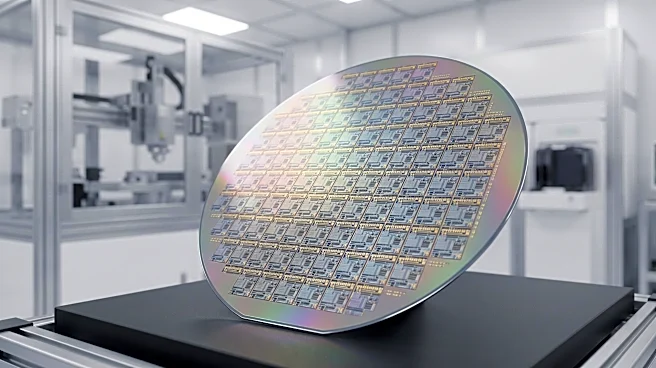
role focuses on developing and enabling advanced packaging technology to integrate memory dies and System-on-Chip (SoC) dies into a single package, specifically for AI-related products. Key responsibilities include defining the packaging technology roadmap for future product needs over a 3-5 year horizon, supporting the development of critical components like High Bandwidth Memory (HBM), integrated Voltage Regulators (iVR), and Silicon Capacitors for advanced packaging. The engineer will also manage reliability testing for new technology qualification and lead yield improvement activities during new technology ramp-up. The position requires extensive experience in areas such as 2.5D/3D and HBM technology development, along with expertise in reliability and yield improvements. Project management and teamwork skills are essential, emphasizing innovation, development, and enablement.
Why It's Important?
This recruitment highlights Broadcom's strategic investment in advanced packaging technology, which is crucial for enhancing the performance and efficiency of AI accelerators and networking chips. As AI workloads become more complex and data-intensive, the ability to integrate multiple components into a single package is vital for achieving higher computational power and reducing latency. This move positions Broadcom to meet the growing demand from hyperscalers and other clients who require specialized, high-performance silicon for their AI infrastructure. The development of custom AI accelerators, as an alternative to merchant GPUs, signifies a shift in the semiconductor industry, where companies like Broadcom are enabling tailored solutions for specific workloads. This focus on advanced packaging also underscores the competitive landscape in the semiconductor sector, where innovation in manufacturing and integration is key to maintaining a market edge and supporting the rapid evolution of AI technologies.
What's Next?
Broadcom's continued investment in advanced packaging technology suggests a future where more complex and integrated AI chips will become standard. The successful candidate for this role will be instrumental in shaping the company's technological roadmap and product offerings in the AI space. This focus on custom silicon development indicates that Broadcom will likely continue to collaborate closely with hyperscalers to design chips optimized for their unique AI and networking requirements. The company's ability to deliver these advanced solutions will be critical for its growth and market position in the coming years, especially as the demand for AI infrastructure continues to surge. Furthermore, this trend could lead to increased competition among semiconductor companies to develop more sophisticated packaging and integration techniques, potentially driving further innovation across the industry.
Beyond the Headlines
The emphasis on advanced packaging technology reflects a broader industry trend towards heterogeneous integration, where different types of chips are combined into a single, high-performance unit. This approach is becoming increasingly important as traditional Moore's Law scaling faces physical limitations. By integrating memory and SoC dies, Broadcom is addressing critical bottlenecks in data transfer and power consumption, which are significant challenges in AI computing. This technological advancement has implications beyond just performance; it also impacts the environmental footprint of data centers by improving energy efficiency. The demand for specialized AI chips also raises questions about the future of general-purpose computing and the increasing customization of hardware for specific applications, potentially leading to a more fragmented but highly optimized hardware ecosystem. This strategic direction could also influence supply chain dynamics, as the complexity of these integrated packages requires sophisticated manufacturing processes and strong partnerships with foundries.