

What's Happening?
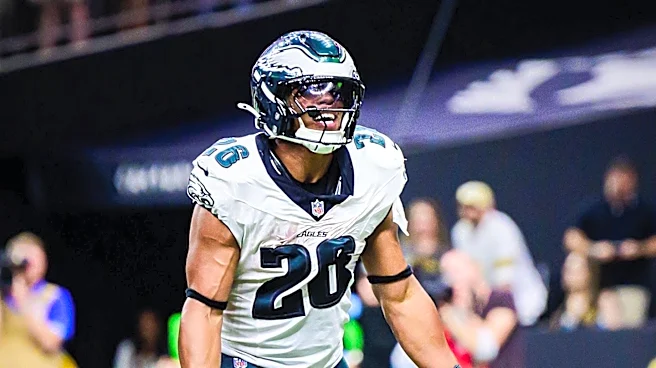
Philadelphia Eagles running back Ja'Quinden Jackson suffered an injury during the opening kickoff of Saturday's game against the New England Patriots. The team announced that Jackson has 'strength and movement in all extremities' and was transported to
a local hospital for further evaluation. The incident occurred when Jackson attempted a tackle and appeared to take a knee to the head, causing him to fall onto his back. Athletic trainers from both teams immediately attended to him, and an ambulance was brought onto the field. Jackson was then loaded onto a backboard before being taken to the hospital. Jackson, an undrafted player from the 2025 NFL Draft, spent last season with the Jacksonville Jaguars but did not see any game action. He was waived by the Jaguars this offseason and is currently in training camp with the Eagles, aiming to secure a spot on the 53-man roster or practice squad for the upcoming regular season. The Eagles' running back depth chart includes Saquon Barkley as the starter, with Tank Bigsby as the main backup, followed by Will Shipley and Dameon Pierce.
Why It's Important?
This incident highlights the inherent risks of professional football, particularly during special teams plays like kickoffs, which are often among the most high-impact moments in a game. For Ja'Quinden Jackson, an undrafted player fighting for a roster spot, any injury, especially one requiring immediate hospitalization, can significantly impact his career trajectory. His current status in training camp is precarious, as teams often make roster decisions based on player availability and performance during the preseason. While the initial reports of 'strength and movement in all extremities' are positive, the full extent of his injury and recovery timeline will be crucial for his chances with the Eagles. For the team, while Jackson is not a projected starter, his potential absence could affect the depth of their running back room, especially if other players face injuries during the demanding NFL season. The incident also serves as a reminder of the ongoing efforts and concerns regarding player safety in the NFL, particularly concerning head injuries.
What's Next?
The immediate next step for Ja'Quinden Jackson will be further medical evaluation at the local hospital to determine the full extent of his injury. The Eagles will likely provide updates on his condition as more information becomes available. Depending on the diagnosis, Jackson could face a recovery period that might sideline him for the remainder of the preseason, potentially jeopardizing his opportunity to make the Eagles' final roster. If the injury is severe, it could lead to him being placed on injured reserve, which would end his season. For the Eagles, they will continue to assess their running back depth as training camp progresses, with Saquon Barkley, Tank Bigsby, Will Shipley, and Dameon Pierce vying for roles. The team will need to decide whether to bring in another running back for depth if Jackson's injury proves to be long-term. The NFL will also continue to monitor player safety protocols, especially in light of such incidents during preseason games.
Beyond the Headlines
Beyond the immediate concern for Ja'Quinden Jackson's health and career, this event underscores the broader narrative of player welfare in the NFL. For undrafted players like Jackson, the preseason is a critical period to prove their worth, and an injury at this stage can be devastating, not just physically but also financially and psychologically. It brings to light the intense competition and the fine line between achieving a dream and facing a career-altering setback. The incident also implicitly raises questions about the long-term health implications for players in a sport known for its physicality, even as the league implements various safety measures. While the NFL has made strides in concussion protocols and player safety, the inherent violence of the game means that such incidents remain a constant risk, prompting ongoing discussions about rule changes, equipment advancements, and medical support for athletes throughout their careers and beyond.