







What's Happening?
The Robotic Process Automation (RPA) and Hyper Automation market is expected to grow at a Compound Annual Growth Rate (CAGR) of 12.5% from 2026 to 2033. This growth is driven by increasing demand for intelligent automation, cloud-based solutions, and the
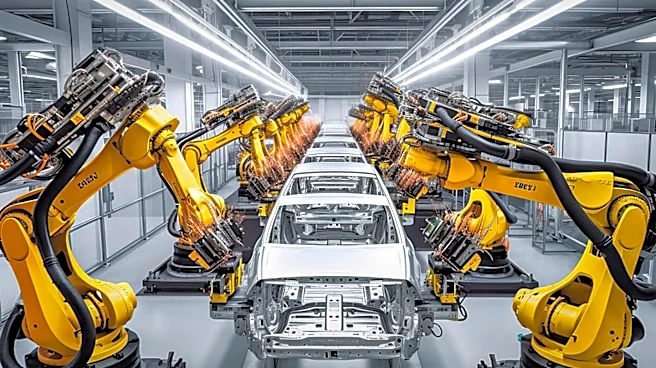
need for operational resilience across various industries. The market is segmented into Intelligent Process Automation (IPA) and Hyperautomation. IPA integrates artificial intelligence with RPA to handle unstructured data and cognitive tasks, while Hyperautomation offers a holistic approach combining IPA, business process management, and advanced analytics. Key applications include automated supply chain management in manufacturing, dealer management in automotive, and claims administration in healthcare. North America, particularly the United States, currently holds the largest market share due to early adoption in sectors like BFSI, healthcare, and IT, with projected growth of 12-14% through 2030.
Why It's Important?
The expansion of the RPA and Hyper Automation market signifies a fundamental shift in how U.S. businesses operate, aiming for enhanced efficiency and resource optimization. By automating routine tasks, companies can reallocate human capital to more strategic initiatives, fostering innovation and competitive advantage in a digital economy. The adoption of these technologies is crucial for maintaining operational resilience, especially in the face of potential supply chain disruptions. Industries such as manufacturing, automotive, and healthcare stand to gain significantly from reduced downtime, optimized logistics, improved customer experiences, and better patient outcomes. The growth in IPA and Hyperautomation also indicates a move towards more complex workflow automation, impacting how businesses manage data and make decisions, ultimately driving productivity and cost savings across the U.S. economic landscape.
What's Next?
The RPA and Hyper Automation market is expected to continue its evolution from simple task automation to comprehensive, intelligent automation ecosystems. Future developments will likely focus on end-to-end process orchestration leveraging AI, machine learning, and process mining. There will be a surge in demand for cloud-native, platform-agnostic solutions, with market participants consolidating capabilities through acquisitions of tools for document understanding, workflow optimization, and generative AI integration. Innovations such as autonomous agents that can self-heal and adapt to UI changes, and the use of large language models to generate automation scripts from natural language descriptions, are anticipated to lower technical barriers and reduce maintenance costs. Businesses should prepare for a hyper-competitive landscape where differentiation will be based on AI maturity and the ability to demonstrate rapid return on investment, leading to increased strategic partnerships and specialized vertical solutions.
Beyond the Headlines
The shift towards hyperautomation has deeper implications beyond immediate efficiency gains. It signals a fundamental change in workforce dynamics, as routine tasks are increasingly handled by automated systems, prompting a need for upskilling and reskilling the human workforce for higher-value, cognitive roles. Ethical considerations surrounding AI-driven decision-making and data privacy will become more prominent, especially as automation integrates further into sensitive sectors like healthcare and finance. The complexity of integrating disparate legacy systems with new automation technologies presents significant challenges, requiring robust governance and security frameworks. Furthermore, the rise of citizen developers, empowered by low-code platforms and natural language script generation, could democratize automation, but also necessitates careful oversight to ensure quality and compliance. This evolution will likely reshape organizational structures, foster new business models, and redefine the human-technology interface in the workplace.