






What's Happening?
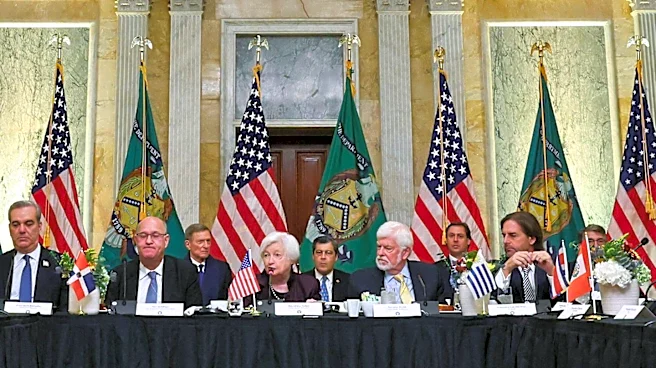
U.S. Treasury Secretary Scott Bessent has publicly affirmed the U.S.'s commitment to joint intervention efforts with Japan to stabilize the yen. Bessent emphasized that a stable yen is crucial for regional stability and for mitigating volatility that could
impact U.S. markets. Following a joint intervention in July, Bessent stated that the U.S. would not hesitate to participate in further coordinated actions. Japan has also been granted access to the Federal Reserve’s Foreign and International Monetary Authorities’ Repo Facility. This facility allows the Bank of Japan (BoJ) to borrow dollars on a short-term basis by pledging U.S. Treasury holdings as collateral, thereby avoiding the need to sell these Treasuries in the open market. Bessent has actively advocated for expanding the use of this facility to enable Japan to acquire dollars for yen-buying without causing spikes in U.S. yields by dumping Treasuries.
Why It's Important?
The U.S. Treasury Secretary's vocal support for yen stabilization underscores the interconnectedness of global financial markets and the U.S.'s vested interest in the economic health of its allies. Japan is the largest foreign holder of U.S. Treasuries, and any significant liquidation of these holdings by Japan to prop up its currency could lead to increased U.S. yields and higher financing costs for the substantial U.S. deficit. Therefore, a stable yen directly benefits the U.S. by preventing potential disruptions in its own bond markets. The provision and encouragement of the Federal Reserve's Repo Facility offer a mechanism for Japan to intervene in currency markets without negatively impacting U.S. financial stability. This collaborative approach highlights a strategic effort to manage currency fluctuations and maintain broader economic stability, benefiting both nations by preventing a domino effect of financial instability.
What's Next?
Despite the U.S. support, the effectiveness of interventions in achieving a lasting turn in the yen's direction remains a challenge, primarily due to the persistent interest-rate gap between Japan and the U.S. While interventions can offer temporary relief and squeeze short positions, the fundamental drivers of yen weakness, such as the carry trade, are likely to persist until this interest-rate differential narrows significantly. Japanese officials have confirmed their intent to utilize the Repo Facility for future operations, indicating a continued reliance on this mechanism. However, market observers suggest that without a meaningful shift in monetary policy from the Bank of Japan, even well-coordinated interventions will likely serve as temporary brakes rather than long-term solutions. The U.S. will likely continue to monitor the situation and potentially engage in further joint interventions if market volatility threatens U.S. financial stability.
Beyond the Headlines
The U.S.'s proactive stance in supporting the yen's stability reflects a broader strategy of economic diplomacy and risk management in a highly globalized financial system. Beyond immediate market concerns, a strong and stable Japanese economy is vital for geopolitical stability in Asia, particularly given the complex regional dynamics. The use of the Federal Reserve's Repo Facility as a tool for international financial cooperation sets a precedent for how major economies can collaborate to mitigate currency crises without resorting to actions that could harm each other's financial markets. This approach highlights a sophisticated understanding of financial interdependence, where the economic health of one major player can have significant ripple effects across global markets, necessitating coordinated policy responses to safeguard collective stability.