

What's Happening?
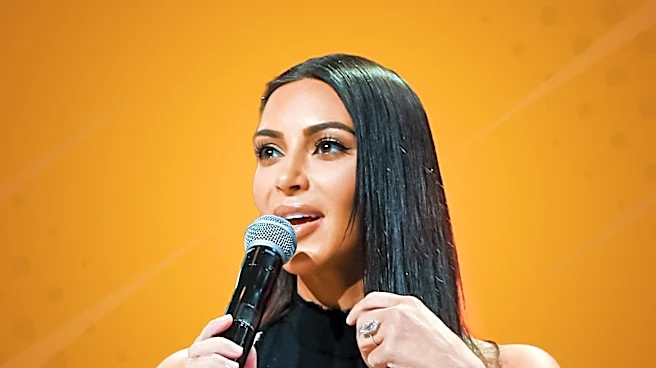
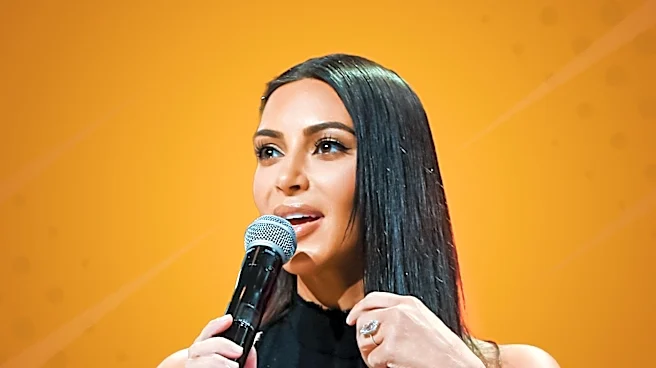
Kim Kardashian reiterated her disbelief in the 1969 moon landing during a recent episode of 'The Kardashians', stating to scientist Dr. Kate Biberdorf, "I’m a, like, we-didn’t-land-on-the-moon kind of gal." This sentiment was echoed by Scott Disick, who
added, "Not a chance we landed on the moon." Dr. Biberdorf, a Notre Dame science professor, countered these claims, asserting, "I definitely think we landed on the moon. We’ve done it six times." Despite the scientific expert's clarification, the Kardashian family, including Khloé Kardashian, appeared unconvinced, with Khloé stating she was indulging her sister's conspiracy theory. This is not the first time Kim Kardashian has publicly expressed her skepticism, having previously shared her opinion in a 2025 episode of the show, citing Buzz Aldrin's demeanor as evidence.
Why It's Important?
This public reaffirmation of moon landing skepticism by a prominent figure like Kim Kardashian is important because it highlights the enduring appeal and influence of conspiracy theories, even in the face of overwhelming scientific evidence. When celebrities with vast platforms voice such opinions, it can inadvertently lend credibility to these theories for a segment of their audience, potentially contributing to a broader distrust in established scientific facts and institutions. This incident also underscores the challenge scientists and educators face in combating misinformation, as personal beliefs, even those based on misinterpretations, can be deeply entrenched and resistant to expert correction. For the scientific community, it represents a recurring battle against the spread of pseudoscientific narratives, particularly when amplified by popular culture figures.
What's Next?
The immediate aftermath will likely involve continued discussion on social media platforms and in entertainment news outlets regarding Kim Kardashian's comments. Scientists and educators may use this as an opportunity to re-emphasize the factual basis of the moon landings and the scientific process. However, it is unlikely that Kim Kardashian or other family members will retract their statements, as their public persona often thrives on controversial or unconventional viewpoints. The episode will likely contribute to the ongoing cultural conversation about celebrity influence, scientific literacy, and the spread of misinformation in the digital age. This event may also prompt further discussions about the responsibility of public figures when expressing opinions on matters of historical and scientific fact.
Beyond the Headlines
Beyond the immediate controversy, this event touches upon deeper societal trends, including the erosion of trust in expert authority and the rise of 'alternative facts.' The willingness of a significant public figure to openly dismiss a widely accepted historical and scientific achievement, even after being presented with expert counter-arguments, reflects a broader cultural shift where personal belief can sometimes outweigh empirical evidence. This phenomenon has implications for various aspects of public discourse, from health and climate science to political narratives. It also highlights the power of media, particularly reality television, to shape public opinion and normalize skepticism towards established truths. The incident serves as a microcosm of the larger struggle between evidence-based reasoning and the allure of compelling, albeit unfounded, narratives in contemporary society.