




What's Happening?
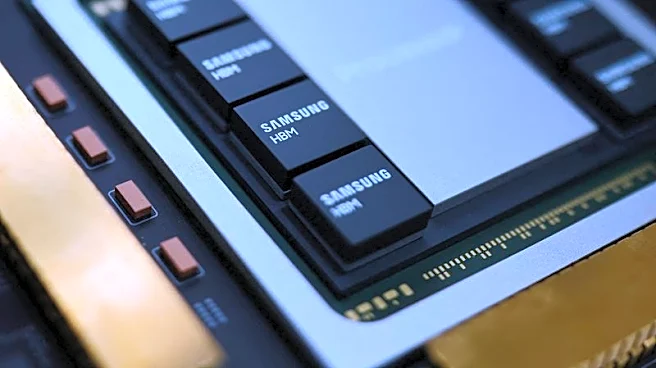
SK Hynix, a leading supplier of high-bandwidth memory (HBM) for NVIDIA's AI accelerators, is expanding its production capacity to meet surging demand in the AI sector. Despite its market leadership and robust AI-driven demand, the company's stock trades
at a significantly lower trailing price-to-earnings (P/E) ratio of 9.7x compared to its rival, Micron Technology, which trades at 21.3x, according to Benzinga Pro. The gap is also evident in EV-to-EBITDA ratios, with SK Hynix at 8.2x versus Micron's 15.3x. While forward valuations are similar, suggesting strong expected earnings growth for both, the current disparity in trailing multiples indicates a potential 'Korea discount' applied to SK Hynix, influenced by factors like governance structures, capital allocation practices, and geopolitical risks in South Korea. SK Hynix has announced a record 40 trillion won ($28.6 billion) share buyback and an enhanced shareholder return policy to address this perception.
Why It's Important?
This valuation disparity between SK Hynix and Micron, despite SK Hynix's leadership in the critical AI memory market, has significant implications for U.S. investors and the semiconductor industry. U.S. investors seeking exposure to the booming AI sector might overlook SK Hynix due to its lower valuation multiples, potentially missing out on a company at the forefront of AI hardware innovation. The 'Korea discount' phenomenon, if persistent, could affect capital flows and investment decisions in the global semiconductor market. For U.S. companies like NVIDIA, which rely on SK Hynix for HBM, the financial health and market perception of their key suppliers are crucial. A sustained undervaluation could impact SK Hynix's ability to raise capital for future expansions, potentially affecting the supply chain for AI accelerators and, consequently, the pace of AI development in the U.S. and globally.
What's Next?
SK Hynix's aggressive shareholder return policy, including a record share buyback and a commitment to return over 50% of cumulative free cash flow between 2025 and 2027, aims to narrow the valuation gap with competitors like Micron. Investors will closely monitor whether these measures, combined with sustained leadership in AI memory, can improve market perception and valuation. The technical momentum for SK Hynix stock is turning positive, with shares reclaiming key moving averages and momentum indicators strengthening, suggesting investors are beginning to reward the company's improving fundamentals. The critical question remains whether SK Hynix can maintain its leadership in the AI memory market and if the market will eventually re-evaluate its valuation to reflect its strong position in a high-growth sector.
Beyond the Headlines
The valuation discrepancy between SK Hynix and Micron highlights the complex interplay of market fundamentals, geopolitical factors, and investor sentiment in the global technology sector. Beyond the immediate financial metrics, the 'Korea discount' points to broader issues of corporate governance and investor confidence in non-U.S. markets. This situation could prompt a re-evaluation of how geopolitical risks and regional market characteristics influence the valuation of global tech leaders. For the U.S., understanding these dynamics is crucial for maintaining a robust and diversified supply chain for critical technologies like AI memory. It also underscores the challenge for investors in discerning true value when market perceptions are influenced by factors beyond operational performance, potentially leading to misallocations of capital in the rapidly evolving AI landscape.