

What's Happening?
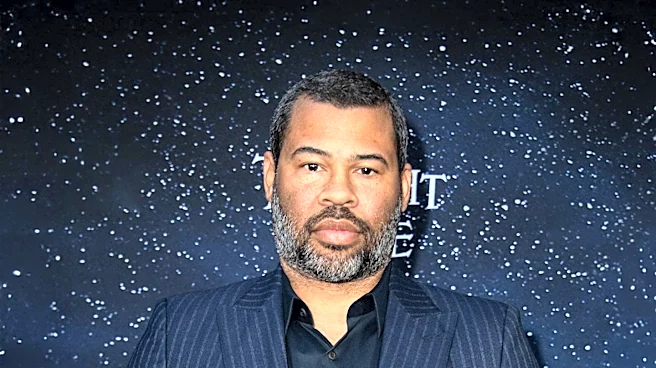
Oscar-winning director Jordan Peele maintains a highly private personal life, particularly concerning his wife and young son, Nez. Despite his significant public profile as a filmmaker known for works like 'Get Out' and 'Us,' Peele has deliberately shielded
his family from media scrutiny and tabloid attention. His son, born in 2018, has never appeared on camera or social media, and photographs of him are rare and not released by Peele himself. This intentional approach to privacy extends to daily family routines, education decisions, and personal moments, which are kept within trusted circles. Peele's philosophy emphasizes control and intention, viewing privacy not just as protection but as a matter of respect for his family, ensuring his son experiences a childhood untainted by public expectation or exposure. This stance contrasts sharply with typical celebrity culture, where personal lives are often extensively publicized.
Why It's Important?
Jordan Peele's deliberate choice to safeguard his family's privacy carries significant implications for the discourse surrounding celebrity, media intrusion, and parental responsibility. In an era where public figures often leverage their personal lives for publicity, Peele's approach offers a counter-narrative, suggesting that true mastery can involve the careful, often invisible work of maintaining a private life. This stance challenges the prevailing media landscape's hunger for behind-the-scenes glimpses, redefining what celebrity parenting can look like by prioritizing fundamental respect for boundaries over viral moments. His example highlights the psychological toll public exposure can exact, especially on young children, and positions his family as a model of intentional celebrity parenthood. This could influence other public figures to reconsider their own approaches to privacy, fostering a broader cultural conversation about the ethics of media coverage and the rights of individuals, particularly children, to a private upbringing.
What's Next?
It is expected that Jordan Peele will continue his steadfast commitment to protecting his family's privacy. His management team has publicly supported a 'low-profile parenting strategy,' indicating that this is a sustained and deliberate choice rather than a temporary measure. Future public appearances and interviews are likely to maintain the existing boundaries, with Peele continuing to share only carefully chosen glimpses of his personal life, primarily through heartfelt remarks at award ceremonies or rare public family moments that do not compromise his son's anonymity. This consistent approach suggests that Nez's future will remain largely outside the public narrative, shaped by Peele's personal decisions rather than external pressures. The ongoing discourse around celebrity privacy may see Peele's example cited as a benchmark for maintaining personal sanctuary in the public eye, potentially influencing how media outlets approach reporting on the families of public figures.
Beyond the Headlines
Jordan Peele's unwavering dedication to his family's privacy extends beyond mere personal preference; it serves as a profound cultural statement in an age of pervasive digital exposure. By actively resisting the commodification of his family life, Peele implicitly critiques the relentless demands of celebrity culture and the erosion of personal boundaries. This deliberate seclusion transforms his family's existence into an artistic statement, suggesting that some narratives, particularly those of love and family, deserve to unfold quietly, away from the pressures of headlines and public scrutiny. This aligns with Peele's filmmaking, which often challenges viewers to look beyond surface truths and question what is shown versus what remains obscured. His actions invite a deeper reflection on what society gains and loses when fame necessitates constant exposure, highlighting the ethical dimensions of media consumption and the intrinsic value of an unexposed childhood. It underscores a long-term shift towards valuing authenticity and intentionality in an increasingly performative public sphere.