








What's Happening?
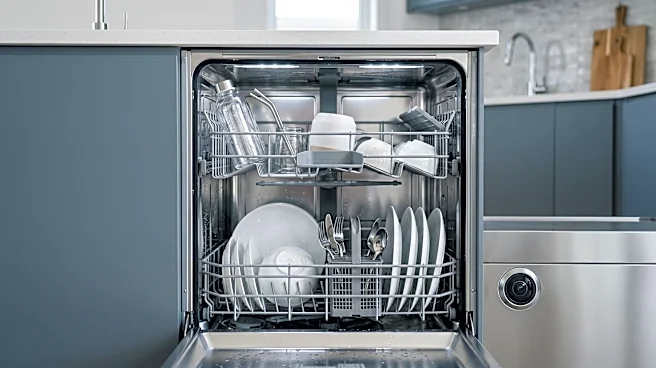
Miele has unveiled its new Diamond G8 dishwasher, which features an AI-powered camera designed to recognize different types of dishes and adjust wash cycles accordingly. The camera, located on the back of the dishwasher door, surveys the interior to identify
common kitchen items, such as portable bottles, reusable straws, pots, and pans. Based on this inventory, the dishwasher's AI system tailors the wash cycle and detergent volume to ensure optimal cleaning. For instance, it can trigger a more intensive cycle for pots and pans or a lighter cycle for smaller loads, conserving hot water and soap. The Diamond G8 also includes other AI-powered features for efficiency, such as water and energy monitoring accessible via Miele's app, a smart detergent-dispensing system, and an enhanced hot-air drying system. Miele plans to launch the Diamond G8 in the European market later this year, with consideration for a North American strategy.
Why It's Important?
This innovation by Miele signifies a growing trend in the home appliance industry towards integrating advanced AI and sensor technology to enhance functionality and efficiency. For U.S. consumers, the potential introduction of the Diamond G8 could offer a new level of convenience and resource optimization in household chores. The ability of a dishwasher to intelligently adapt its operations based on load content could lead to significant savings in water and energy consumption, aligning with increasing consumer demand for eco-friendly and cost-effective solutions. Furthermore, the focus on practical problem-solving, rather than mere novelty, suggests a maturing market for smart home devices where utility and performance are prioritized. This could influence other manufacturers to develop similar AI-driven features, fostering competition and accelerating the adoption of more intelligent and efficient appliances across the U.S. market.
What's Next?
Miele is currently focused on rolling out the Diamond G8 in the European market later this year. Following this, the company will evaluate its strategy for a North American launch. The success of the Diamond G8 in Europe, particularly its reception regarding efficiency and performance, will likely influence the timeline and marketing approach for its U.S. debut. While a retail price is yet to be announced, it is anticipated to be in the 'super-premium zone,' suggesting a target market of consumers willing to invest in high-end, technologically advanced home appliances. Potential next steps include Miele conducting market research in North America to assess consumer interest and demand, as well as navigating regulatory requirements for smart appliances. The company will also need to establish distribution channels and service networks to support a North American launch.
Beyond the Headlines
The integration of AI cameras into everyday appliances like dishwashers raises broader questions about data privacy and the future of smart homes. While Miele's camera is designed for internal inventory and cycle optimization, the increasing presence of cameras and sensors in private spaces could lead to discussions about data collection, storage, and security. Consumers may become more discerning about the types of data their appliances collect and how that data is used. This development also highlights a shift in consumer expectations, where appliances are no longer just functional tools but intelligent assistants capable of autonomous decision-making. The long-term implication could be a more interconnected and automated home environment, where appliances communicate and coordinate to optimize resource usage and convenience, potentially leading to new standards for home efficiency and smart living. However, this also necessitates robust cybersecurity measures and clear privacy policies from manufacturers.