








What's Happening?
AI-driven smart ear tags are transforming livestock management in the U.S., offering advanced monitoring capabilities for cattle producers. Companies like Merck, 701x, and Ceres are providing solutions that track animal behavior, detect health issues,
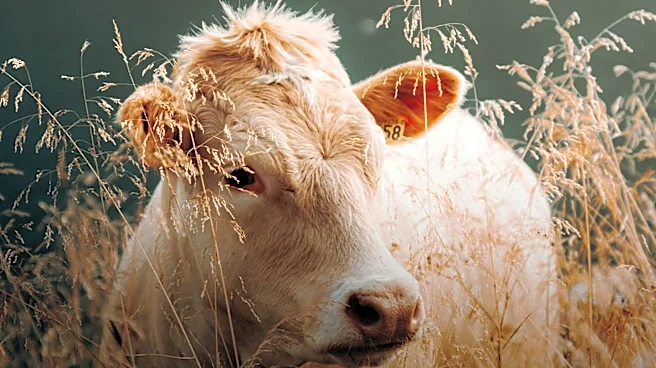
and optimize reproductive cycles. Merck's SenseHub Cow Calf system uses accelerometer technology to monitor behavior 24/7, providing insights into estrus detection and health outliers for earlier treatment. The 701x xTpro tag, functional anywhere in the U.S., communicates via Bluetooth, cellular, and satellite, delivering real-time alerts on individual health concerns, activity levels, GPS location, and reproductive events. Ceres Tag, the world's first direct-to-satellite cattle intelligence platform, features IP68 waterproof, solar-powered ear tags that combine scientifically verified phenotype algorithms and GPS services to monitor pasture feed intake, estrus, and calving alerts without the need for base stations. These systems aim to improve cattle productivity and welfare by providing actionable data to producers.
Why It's Important?
The adoption of AI-powered smart ear tags is a significant development for the U.S. livestock industry, addressing critical challenges in animal health, reproduction, and operational efficiency. By providing continuous, real-time data on individual animals, these technologies enable proactive management, reducing losses due to illness and improving breeding success rates. This leads to more sustainable and profitable cattle operations. The ability to detect estrus and calving alerts precisely can optimize artificial insemination programs, a key factor in genetic improvement and herd expansion. Furthermore, early detection of health problems can minimize the spread of disease and reduce veterinary costs. The integration of satellite and cellular communication ensures functionality across vast ranching landscapes, making these tools accessible and effective for a wide range of producers, from small farms to large-scale operations. This technological advancement is crucial for enhancing food security and the economic viability of the U.S. agricultural sector.
What's Next?
The market for AI-driven agricultural tools, including smart ear tags, is expected to continue its rapid expansion, fueled by venture capital and corporate partnerships. Further innovation will likely focus on enhancing data analytics, integrating with other farm management systems, and improving battery life and durability of the tags. The USDA's investment in projects like GeoAI-Dairy, which models dairy supply-chain networks and predicts avian-flu transmission, indicates a growing governmental interest in leveraging AI for agricultural resilience and biosecurity. As these technologies become more sophisticated and affordable, their adoption across the U.S. livestock industry will likely increase, leading to more data-driven decision-making. Future developments may also include more advanced predictive analytics, allowing producers to anticipate issues before they arise, and potentially, the integration of these systems with broader environmental monitoring to optimize grazing patterns and resource use.
Beyond the Headlines
The rise of AI in livestock management, exemplified by smart ear tags, extends beyond mere efficiency gains; it touches upon ethical considerations of animal welfare and the broader implications for food production systems. The continuous monitoring capabilities offer unprecedented insights into animal well-being, potentially leading to higher standards of care and more humane practices. However, it also raises questions about data privacy and ownership in agriculture, as vast amounts of animal data are collected and analyzed. The shift towards precision livestock farming, driven by AI, could also lead to a more industrialized approach to animal agriculture, with both benefits and drawbacks for small-scale farmers and traditional practices. Furthermore, the ability to track and predict disease transmission pathways, as seen with GeoAI-Dairy, has significant implications for public health and food safety, highlighting the interconnectedness of agricultural technology with societal well-being and global health security.