





What's Happening?
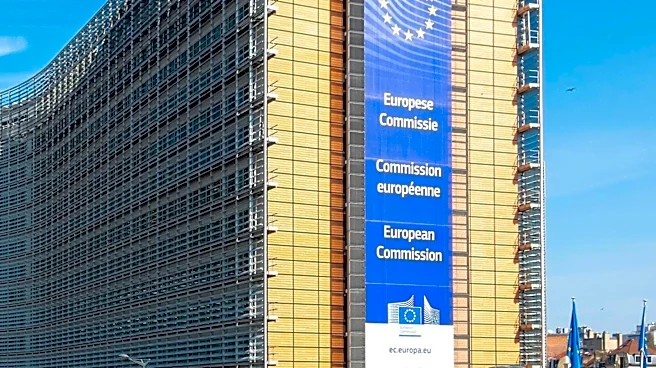
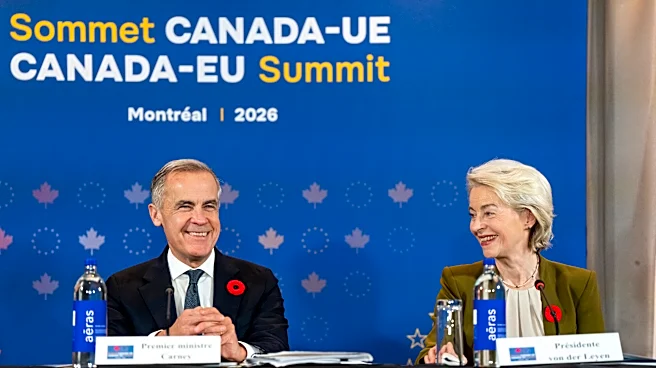
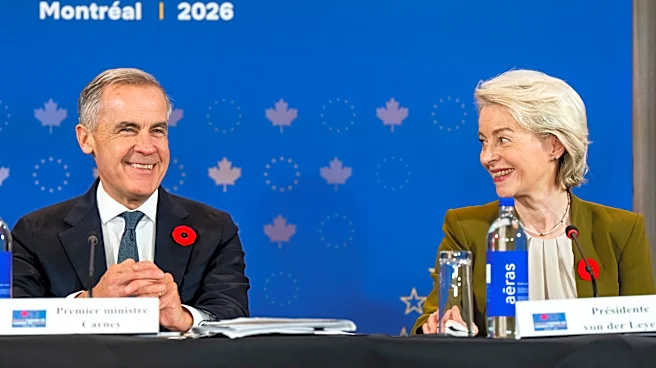
The European Investment Bank (EIB) has signed a framework agreement to commence operations in Canada, with an initial focus on projects related to critical minerals. This agreement is part of a broader new cooperation framework between the European Union
and Canada, aiming to reshape strategic supply chains, remove market barriers, and unlock investment flows. The EIB's involvement in Canada's essential mineral projects is intended to secure the supply of these minerals for defense development and energy transition. This move complements the Comprehensive Economic and Trade Agreement (CETA) and seeks to enhance economic ties between the EU and Canada. The cooperation also extends to exploring the export of liquefied natural gas from Canada to the EU, promoting clean energy, nuclear technology, and energy infrastructure protection. Additionally, both parties agreed to boost cooperation in artificial intelligence, connectivity, and satellite positioning.
Why It's Important?
This expansion of the EIB into Canada, particularly its focus on critical minerals, holds significant importance for the U.S. and its allies. The secure supply of critical minerals is vital for various high-tech industries, defense applications, and the global transition to clean energy technologies. By strengthening the critical mineral supply chain between Canada and the EU, this initiative could indirectly benefit U.S. industries that rely on these materials, potentially diversifying sources and reducing dependence on less stable regions. Furthermore, increased cooperation between Canada and the EU on clean energy and nuclear technology could accelerate the development and deployment of sustainable energy solutions, impacting global energy markets and potentially influencing U.S. energy policy and investment. The broader goal of reshaping strategic supply chains also aligns with U.S. efforts to enhance supply chain resilience and reduce vulnerabilities.
What's Next?
Following the signing of the framework agreement, the EIB is expected to begin identifying and financing specific critical mineral projects in Canada. This will likely involve detailed assessments of potential projects, due diligence, and the establishment of financing mechanisms. The broader cooperation framework between the EU and Canada will also see continued efforts to reduce market barriers and facilitate investment flows, potentially leading to new trade agreements or amendments to existing ones. Discussions regarding the export of liquefied natural gas from Canada to the EU will likely progress, which could impact global energy markets and energy security. Furthermore, enhanced collaboration in areas like artificial intelligence and satellite positioning could lead to joint research and development initiatives, with potential implications for technological advancements and international standards.
Beyond the Headlines
The EIB's entry into Canada and its focus on critical minerals highlight a growing global trend towards securing essential resources and diversifying supply chains in an increasingly complex geopolitical landscape. This move underscores the strategic importance of critical minerals, not just for economic growth but also for national security and the transition to a green economy. The collaboration between the EU and Canada could set a precedent for other international partnerships aimed at resource security and technological advancement. It also reflects a broader shift away from reliance on single-source suppliers, particularly in light of recent global disruptions. The emphasis on clean energy and nuclear technology also points to a concerted effort among Western allies to accelerate decarbonization while ensuring energy independence and resilience.