




What's Happening?
South Korea's SK Hynix announced a plan to invest 1.4 trillion won (approximately $1.05 billion) over the next five years to support its domestic suppliers of semiconductor materials, parts, and equipment. This initiative aims to strengthen its supply
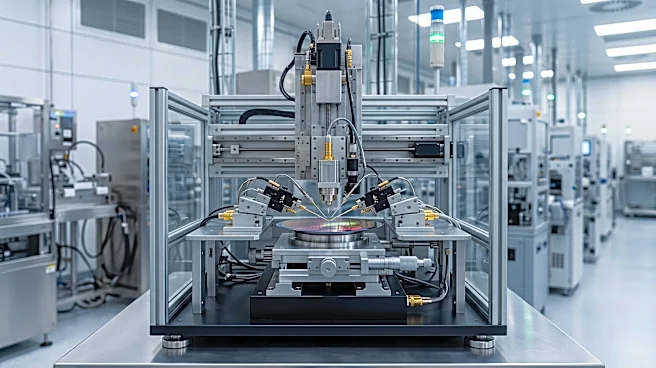
chain as competition intensifies within the AI chip market. The chipmaker also detailed plans for an 874.6 billion won jointly funded testing facility, named Trinity Fab, at its semiconductor complex in Yongin, south of Seoul. This facility, scheduled to open in May 2027, will allow smaller suppliers to test products under conditions mirroring commercial chip production lines. SK Hynix's supplier support program encompasses four stages: research and development, testing, mass production, and sales, designed to help smaller companies overcome financial and technological hurdles. The Trinity Fab is a collaborative effort between SK Hynix, the central government, and local governments, with SK Hynix contributing 443.2 billion won.
Why It's Important?
This significant investment by SK Hynix underscores a strategic move to enhance the resilience and competitiveness of its domestic semiconductor supply chain. By supporting local suppliers, SK Hynix aims to reduce reliance on foreign components, a critical factor in an increasingly volatile global market. The establishment of the Trinity Fab will provide invaluable resources for smaller companies, fostering innovation and accelerating product development by offering access to advanced testing environments. This could lead to a more robust and self-sufficient semiconductor ecosystem in South Korea, potentially setting a precedent for other nations looking to secure their own tech supply chains. For the U.S., a stronger and more diversified global semiconductor supply chain could lead to greater stability and potentially more competitive pricing for critical components, benefiting U.S. tech companies and consumers.
What's Next?
The Trinity Fab is slated to open in May 2027, marking a crucial step in the implementation of SK Hynix's strategy. Over the next five years, the company will disburse the committed funds through various programs, including upfront development cost coverage, low-interest loans, and technical consulting for suppliers. The success of this initiative will likely be measured by the increased market share and technological advancements of its domestic suppliers, as well as the overall strengthening of SK Hynix's position in the AI chip market. Other global semiconductor giants may observe this model closely, potentially influencing similar investments in their respective domestic supply chains. The long-term impact could be a more localized and resilient global semiconductor industry, reducing vulnerabilities to geopolitical tensions and supply disruptions.
Beyond the Headlines
The move by SK Hynix reflects a broader global trend towards national self-sufficiency and supply chain de-risking in critical technology sectors. As geopolitical tensions rise and the demand for advanced semiconductors, particularly for AI, continues to surge, countries and major corporations are increasingly prioritizing domestic capabilities. This initiative could foster a new era of localized innovation and manufacturing, potentially leading to a more fragmented yet resilient global tech landscape. The ethical implications include ensuring fair competition and preventing monopolistic practices within these newly strengthened domestic ecosystems. Furthermore, the focus on intellectual property protection within the Trinity Fab highlights the growing importance of safeguarding proprietary technologies in a highly competitive industry.