

What's Happening?
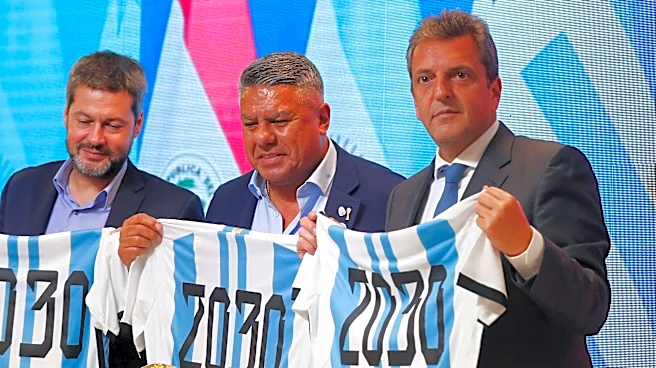
The 2030 FIFA World Cup is set to be a historic event, with matches hosted across multiple continents for the first time. The tournament will be jointly hosted by Morocco, Portugal, and Spain, with additional matches in Uruguay, Argentina, and Paraguay
to commemorate the World Cup's centenary. This decision marks a significant expansion from the 2026 tournament, which was held in three countries. The 2030 edition will feature 48 teams, with discussions ongoing about potentially increasing the number to 64. The inclusion of South American countries for select matches honors the tournament's origins, as Uruguay hosted the first World Cup in 1930.
Why It's Important?
The 2030 World Cup represents a major shift in how global sporting events are organized, reflecting FIFA's commitment to inclusivity and global representation. By hosting matches across different continents, the tournament aims to engage a broader audience and celebrate the World Cup's rich history. This approach also highlights the logistical and infrastructural challenges of coordinating such a large-scale event. The decision to include South American countries for centenary matches acknowledges the region's historical significance in football and may influence future bidding processes for international tournaments.
What's Next?
As preparations for the 2030 World Cup continue, host countries will focus on infrastructure development and logistical planning to accommodate the expanded format. FIFA will also address the potential increase in participating teams, which could impact tournament scheduling and venue selection. The event's success will depend on effective collaboration between host nations and FIFA, as well as the ability to deliver a seamless experience for players and fans. The tournament will serve as a test case for future multi-continent sporting events, potentially setting a precedent for other international competitions.