





What's Happening?
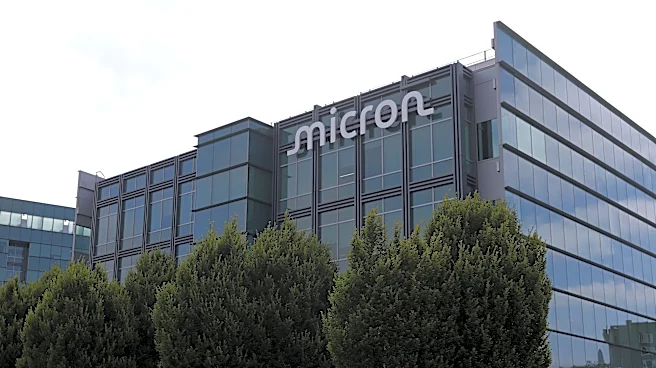
Micron Technology, a key producer of DRAM, NAND, and high-bandwidth memory (HBM) essential for AI accelerators, is experiencing significant market volatility despite robust demand for its products. The company reported fiscal 2026 revenue of $133.188
billion, a 256.33% increase, with non-GAAP EPS reaching $75.52. However, a recent chip sell-off has pushed its shares significantly below their 52-week high of $1,254.61. Micron's fiscal Q1 guidance projects revenue of $61.5 billion ± $1.5 billion and non-GAAP EPS of $38.15 ± $1.00. The company has committed over 75% of its shipments for the year through 26 strategic supply agreements, indicating strong current demand. Despite beating earnings estimates for nine consecutive quarters, the stock has frequently seen sell-offs post-earnings, highlighting investor caution regarding the memory market's cyclical nature.
Why It's Important?
Micron's performance is a critical indicator for the broader technology and AI sectors, as its HBM products are fundamental to AI accelerators. The strong demand for AI memory underscores the rapid expansion of AI applications and data center investments, which are driving significant growth in the semiconductor industry. However, the inherent cyclicality of the memory market poses a continuous challenge, leading to sharp price swings and investor uncertainty. The company's ability to maintain price increases and effectively utilize its $35 billion buyback program will be crucial for its stock performance. The disconnect between strong operational results and post-earnings stock declines suggests that investors are keenly focused on long-term market stability and the sustainability of current demand, rather than just short-term beats.
What's Next?
Investors are closely watching for two key developments to settle the debate around Micron's valuation: concrete evidence of significant HBM price increases for calendar year 2027 and clear indications of active share buyback utilization. The consensus fiscal Q1 EPS estimate is very close to the company's guidance, meaning an ordinary earnings beat might not be sufficient to significantly move the stock. The company's thesis could falter if management revises its fiscal 2027 outlook downwards or if customers push back on contract pricing. With a high beta of 2.398, sharp price swings are anticipated, especially around upcoming earnings reports. Future construction spending on clean rooms, expected to come online in late 2028 and beyond, will also influence long-term supply and demand dynamics.
Beyond the Headlines
The situation with Micron highlights a broader tension within the high-growth technology sector: how to reconcile explosive demand driven by transformative technologies like AI with the historical cyclicality of hardware components. While AI demand appears robust and long-term, the memory market's tendency for boom-and-bust cycles creates a unique investment challenge. This dynamic could lead to a re-evaluation of traditional valuation metrics for semiconductor companies, as investors grapple with pricing in both peak-cycle demand and potential future downturns. The emphasis on HBM pricing for 2027 suggests that the market is looking for sustained pricing power, not just volume, to justify higher valuations, indicating a shift towards valuing strategic positioning in critical AI supply chains.