



What's Happening?
Chris Olah, a co-founder of Anthropic, has achieved an estimated $18 billion valuation for his stake in the company. His career trajectory is notable for its departure from conventional academic and professional norms. Olah initially studied mathematics
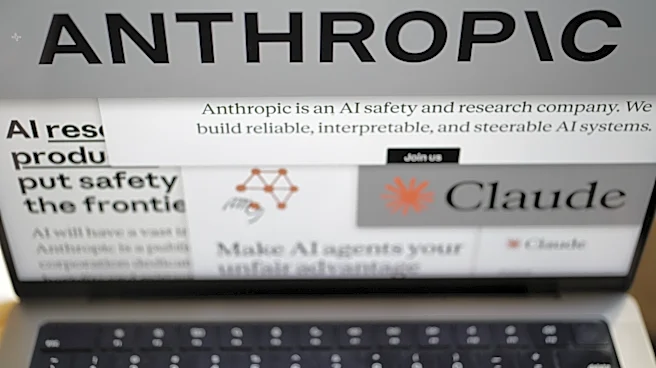
at the University of Toronto but left after only a year. In 2012, he received a $100,000 fellowship from Peter Thiel, an initiative designed to encourage young individuals to skip college and pursue entrepreneurial endeavors. Without a formal degree, Olah cultivated his expertise by writing extensively about machine learning on his personal blog. His explanations, particularly on complex topics like LSTMs, garnered significant attention from AI researchers globally. This public demonstration of his knowledge and analytical skills led to his recruitment by Google Brain. Subsequently, in 2018, he joined OpenAI to lead research into the inner workings of neural networks. In 2021, Olah, along with six other colleagues, departed from OpenAI to establish Anthropic, an AI safety and research company.
Why It's Important?
Olah's story serves as a compelling example of how the U.S. technology industry, particularly in the field of artificial intelligence, is increasingly valuing demonstrated skill and public contribution over traditional academic credentials. His success, culminating in an $18 billion stake, highlights a potential paradigm shift where personal blogs and open-source contributions can act as powerful 'proof of work,' effectively replacing or supplementing traditional resumes and interviews. This trend could significantly impact how talent is identified and nurtured within the tech sector, potentially opening doors for individuals from diverse backgrounds who may not have access to conventional educational pathways. For U.S. businesses, it suggests a broader talent pool and a more meritocratic hiring environment, where the ability to explain complex concepts and contribute meaningfully is paramount.
What's Next?
The continued success of individuals like Chris Olah is likely to further influence hiring practices and educational philosophies within the U.S. tech industry. Companies may increasingly look for candidates who have a strong online presence, a history of public contributions, and the ability to articulate complex technical concepts clearly. This could lead to a greater emphasis on practical skills and project-based learning in educational institutions, and potentially a decline in the perceived necessity of a four-year college degree for certain high-tech roles. Furthermore, the 'Thiel Fellowship' model, which supported Olah's early career, may gain more prominence, encouraging other philanthropists and investors to support non-traditional educational and career paths for promising young talent in the U.S.
Beyond the Headlines
Olah's journey underscores a profound shift in the valuation of knowledge and expertise in the digital age. His blog, acting as both a portfolio and a platform for intellectual discourse, became his primary credential, demonstrating that credibility can be built through transparent sharing and clear explanation of complex ideas. This phenomenon has broader implications for intellectual property and the open-source movement, suggesting that contributing to the public domain of knowledge can lead to significant personal and professional rewards. It also raises questions about the future role of universities in fostering innovation, as self-directed learning and online communities increasingly provide alternative pathways to expertise. This development could foster a more decentralized and accessible ecosystem for talent development in the U.S., potentially accelerating technological advancements by tapping into a wider range of human potential.