







What's Happening?
Fisker Inc., the electric vehicle company co-founded by Henrik Fisker and Geeta Gupta-Fisker in 2016, has entered Chapter 11 bankruptcy proceedings in June 2024. This development follows significant financial and operational challenges faced by the company.
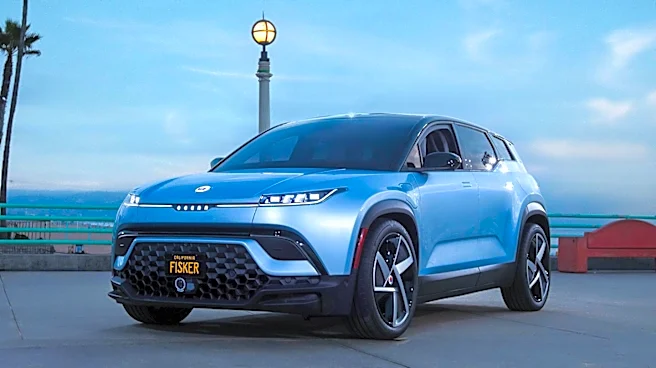
Fisker Inc. had aimed to develop the Fisker Ocean electric SUV and operate with an 'asset-light' model, relying on external manufacturing and technology partnerships. This is not Henrik Fisker's first venture into the electric vehicle market; his previous company, Fisker Automotive, which developed the Fisker Karma luxury plug-in hybrid, also filed for Chapter 11 bankruptcy in 2013 after encountering severe financial and production issues. The current bankruptcy filing for Fisker Inc. and its U.S. entities indicates estimated assets ranging from $500 million to $1 billion, against liabilities estimated between $1 billion and $10 billion, as reported by Reuters at the time of the filing.
Why It's Important?
The bankruptcy of Fisker Inc. underscores the volatile and challenging landscape of the electric vehicle (EV) startup sector in the U.S. and globally. Despite the growing demand for EVs and significant investment in the industry, many new entrants struggle to achieve sustainable production and financial stability. This event highlights the difficulties in scaling automotive manufacturing, even with an 'asset-light' strategy that leverages external partners. For consumers, this means potential uncertainty regarding warranties, service, and resale value for existing Fisker Ocean owners. For the broader automotive industry, it serves as a cautionary tale about the capital-intensive nature of car production and the intense competition from established automakers and well-funded new players. The failure of another EV startup, following others like Arrival and Lordstown, could lead investors to be more cautious about funding similar ventures, potentially consolidating the market around a few dominant players.
What's Next?
Following the Chapter 11 bankruptcy filing, Fisker Inc. will undergo a restructuring process under court supervision. This typically involves assessing assets, negotiating with creditors, and potentially seeking buyers for parts of the business or the entire company. The future of the Fisker Ocean electric SUV and any other planned models remains uncertain. It is likely that the company will either be liquidated, with assets sold off to repay creditors, or a buyer may emerge to acquire its intellectual property, designs, or remaining operational components. For Henrik Fisker, this marks a second significant setback in his entrepreneurial efforts within the EV space. His future involvement in the automotive industry will depend on the outcome of these proceedings and his ability to attract new investment or partners for any subsequent ventures, leveraging his established expertise in automotive design.
Beyond the Headlines
The repeated financial struggles of Fisker's automotive ventures, despite his renowned design background and innovative approaches, point to deeper systemic challenges in the automotive industry beyond just product design. It highlights the immense capital requirements, complex supply chains, and intense regulatory hurdles involved in bringing a new vehicle to market at scale. The 'asset-light' model, while theoretically reducing upfront capital expenditure, still relies heavily on the reliability and capacity of third-party manufacturers, which can introduce its own set of risks and dependencies. This situation also raises questions about the long-term viability of numerous EV startups that have emerged in recent years, many of which are yet to achieve profitability. The market may be entering a phase of consolidation where only the most resilient and well-capitalized companies can survive, potentially stifling innovation from smaller, independent players.