



What's Happening?
Warp Sciences, a South San Francisco-based startup, has emerged from stealth with $215 million in funding. The company aims to accelerate drug discovery for biotech and pharmaceutical companies by integrating chemistry, robotics, and artificial intelligence
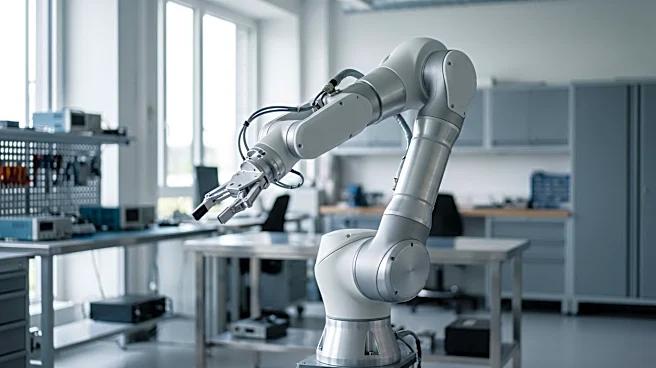
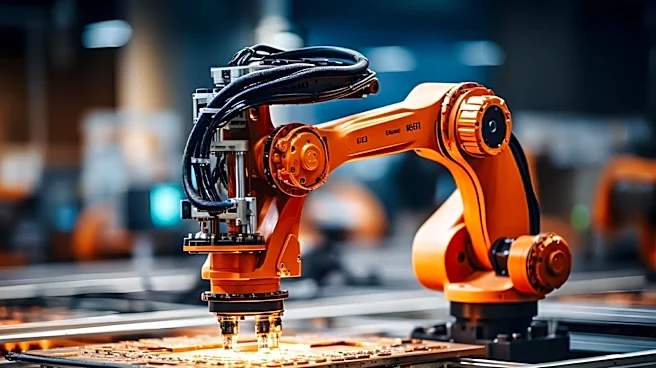
(AI) into a U.S.-based contract research organization (CRO). Warp Sciences plans to build automated labs that can conduct experiments, learn from the results, and continuously improve, thereby generating real-world data to train more capable AI models. The company's initial service will focus on lead optimization analog synthesis, which involves creating variations of molecules for scientists to compare in their search for drug candidates. Experienced chemists will oversee these experiments as the labs become increasingly automated. Warp Sciences emphasizes that it does not have its own proprietary drug pipeline but instead provides infrastructure for other companies to discover drugs more efficiently and securely within the U.S.
Why It's Important?
This initiative is significant for the U.S. pharmaceutical and biotechnology sectors, particularly in the context of 'sovereign biotechnology.' A 2024 survey by the Biotechnology Innovation Organization indicated that 74% of companies had contracts with Chinese firms for preclinical and clinical services. The BIOSECURE Act, enacted in December 2025, established restrictions on federal procurement and funding involving certain biotechnology companies of concern. Warp Sciences' focus on building a U.S.-based chemistry partner addresses concerns about intellectual property protection and supply chain security, offering a domestic alternative to overseas partners. By accelerating the path from molecular design to testing, Warp Sciences aims to provide drug hunters with faster answers and more opportunities to develop life-changing medicines, while also ensuring that sensitive research remains within the U.S. This could reduce reliance on foreign entities and bolster domestic drug discovery capabilities.
What's Next?
Warp Sciences will proceed with establishing its U.S.-based chemistry CRO, integrating robotics and AI into its lab operations. The company's immediate focus will be on lead optimization analog synthesis, providing services to biotech and pharmaceutical customers. As the automated labs generate more data, the AI models will become increasingly sophisticated, further enhancing the efficiency of drug research. The company's founders, who bring expertise from AI, data infrastructure, healthcare, and drug discovery, will guide this development. Warp Sciences will continue to attract talent with robotics and scientific expertise to build out its infrastructure. The success of this model could lead to broader adoption of AI and robotics in drug discovery across the U.S., potentially influencing future policy and investment in domestic biotechnology.
Beyond the Headlines
The emergence of Warp Sciences highlights a broader trend towards the industrialization and automation of scientific research, particularly in fields like chemistry and biology. By closing the loop between designing experiments, executing them, and learning from outcomes, the company aims to create increasingly capable systems for scientific discovery. This approach could fundamentally change how new medicines are developed, moving beyond traditional, often slower, manual processes. The emphasis on 'sovereign biotechnology' also underscores growing geopolitical considerations in scientific research and development, where national security and intellectual property protection are becoming as crucial as scientific innovation. This shift could lead to a re-evaluation of global research collaborations and a greater push for domestic self-sufficiency in critical scientific areas.