






What's Happening?
Researchers at the Swiss Federal Laboratories for Materials Science and Technology (Empa), in collaboration with specialty-chemicals company Elantas, have developed a new epoxy-based composite material designed for airplane and train interiors. This innovative
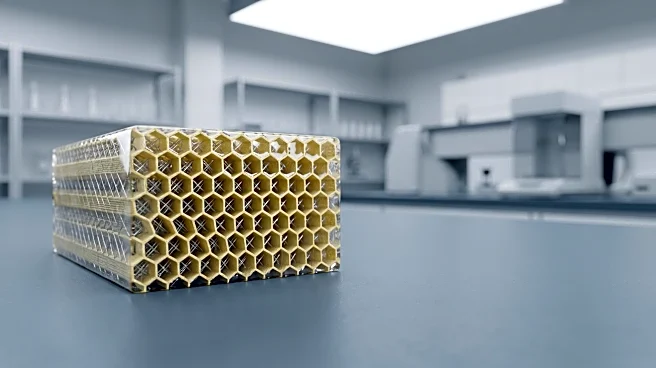
material addresses the long-standing challenge of recycling thermoset polymers like epoxy, which traditionally form permanent, cross-linked networks upon curing, making them difficult to separate and reuse. The key to this breakthrough is a phosphorus-containing additive incorporated into the epoxy during production. This additive not only imparts flame-retardant properties, crucial for aerospace applications, but also allows the cured material to soften and break apart under specific conditions. This reversibility enables the recovery of valuable components, such as aramid honeycomb and reinforcing fibers, from composite structures at the end of their useful life. Conventional epoxy composites typically end up in incinerators or landfills due to their irreversible nature.
Why It's Important?
This development holds significant importance for industries heavily reliant on lightweight, high-strength composite materials, particularly aerospace and rail. The ability to recycle epoxy-based composites could lead to substantial reductions in waste and a more sustainable manufacturing cycle. Currently, valuable materials like carbon and glass fibers, and expensive aramid honeycombs, are often lost when epoxy composites are discarded. By enabling the separation and recovery of these components, the new technology offers a pathway to circularity, reducing the demand for virgin materials and lowering the environmental footprint of these industries. Furthermore, the inherent flame-retardant properties of the new composite eliminate the need for additional fire-retardant treatments, potentially simplifying manufacturing processes and reducing costs. This innovation could also enhance strategic autonomy by allowing for the reuse of materials within domestic supply chains, lessening reliance on external sources.
What's Next?
The immediate next steps involve scaling up both the production of this new composite material and its recycling process. While the researchers have successfully demonstrated the ability to dismantle aerospace-style sandwich composites and recover the individual structural components, the recovery of the epoxy resin itself from the resulting solution is an area for future work. The chemistry behind this innovation is not limited to aircraft; it has potential applications in various other lightweight structures, including cars, trains, ships, and wind turbines. Empa is already exploring its use in the energy and construction industries. Successful scaling and further development of resin recovery could pave the way for widespread adoption, transforming waste streams into valuable feedstocks across multiple sectors and contributing to a more circular economy.
Beyond the Headlines
The deeper implications of this recyclable epoxy composite extend beyond mere waste reduction. It represents a paradigm shift in material science, challenging the long-held notion of thermoset polymers as inherently unrecyclable. This breakthrough could spur further research into 'dynamic' or 'reprocessable' thermosets, leading to a new generation of materials that combine high performance with environmental responsibility. Ethically, it addresses the growing concern over industrial waste and resource depletion, offering a more sustainable alternative for critical infrastructure. Culturally, it reinforces the idea that advanced technological solutions can align with ecological imperatives, potentially influencing consumer and industry expectations for product lifecycle management. The integration of flame retardancy directly into the material's chemistry also highlights a trend towards multi-functional materials, where safety and sustainability are designed in from the outset, rather than being added as afterthoughts.