






What's Happening?
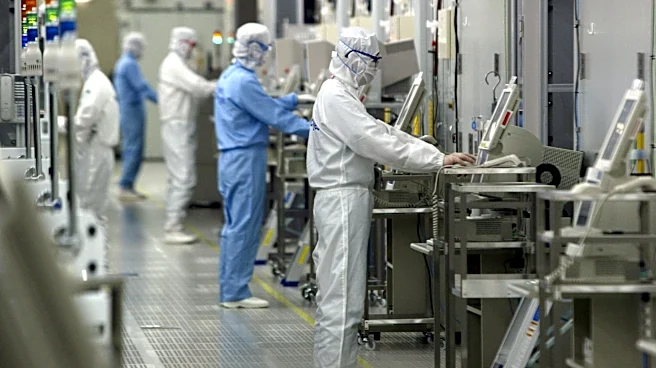
GlobalFoundries, a semiconductor manufacturer, announced a record adjusted gross margin for the third quarter on November 4, 2026, and provided guidance for higher revenue and adjusted earnings in the final quarter of the year. The company reported third-quarter
revenue of $1.899 billion, an increase from $1.688 billion in the previous year. While reported net income showed a loss of $270 million, primarily due to a $441 million non-cash charge related to shares issued to the U.S. government, adjusted net income reached $298 million, with diluted earnings per share at $0.53. The non-IFRS gross margin improved to 31.4% from 26.0% year-over-year, and the non-IFRS operating margin also increased to 17.9%. Management attributed these gains to a richer business mix and strong momentum in communications infrastructure, data center, automotive, and industrial applications. For the fourth quarter, GlobalFoundries anticipates revenue of $2.000 billion, plus or minus $25 million, and non-IFRS diluted earnings per share of $0.59, plus or minus $0.05. The company also highlighted new U.S. fab projects and partnerships aimed at bolstering AI infrastructure.
Why It's Important?
This development is significant for the U.S. semiconductor industry and its strategic independence. GlobalFoundries' strong financial performance, particularly its record adjusted gross margin and optimistic fourth-quarter outlook, signals robust demand for semiconductors across critical sectors like automotive, aerospace and defense, data centers, and AI-related systems. The company's focus on expanding U.S. manufacturing capacity, including an initiative backed by up to $21 billion to support two new semiconductor fabs at its Malta, New York site, directly addresses national security and economic concerns regarding supply chain resilience. An initial investment of approximately $10 billion is slated to accelerate a 300mm fab, with capacity expected by 2029. Furthermore, a separate agreement with TSMC to establish U.S. production of silicon interposers, with volume production anticipated in the first half of 2028, underscores a concerted effort to localize advanced semiconductor manufacturing. This strategic expansion aims to reduce reliance on overseas production, mitigate geopolitical risks, and foster domestic technological innovation, creating jobs and strengthening the U.S. position in the global technology landscape.
What's Next?
GlobalFoundries' immediate next steps involve executing its fourth-quarter guidance, which is supported by demand for AI-related technologies and communications businesses. The company will also focus on advancing its U.S. manufacturing projects, particularly the development of two new semiconductor fabs in Malta, New York. The initial $10 billion investment for the 300mm fab is expected to bring capacity online by 2029, requiring significant capital deployment and operational scaling. Concurrently, the partnership with TSMC for silicon interposer production in the U.S. is set to ramp up volume production in the first half of 2028, necessitating close collaboration and technological integration. These projects will involve substantial construction, equipment procurement, and workforce development. The long-term success of these initiatives will depend on continued government support, sustained market demand for advanced semiconductors, and the company's ability to manage the significant capital requirements and operational complexities associated with such large-scale expansions. Stakeholders, including government officials, investors, and customers, will closely monitor the progress of these U.S.-based manufacturing efforts.
Beyond the Headlines
The expansion of GlobalFoundries' U.S. manufacturing capabilities carries profound implications beyond immediate financial results. It represents a critical step towards re-shoring semiconductor production, a strategic imperative for the U.S. given recent supply chain disruptions and geopolitical tensions. This move could foster a more resilient domestic technology ecosystem, reducing vulnerability to international trade disputes or natural disasters. Ethically, it raises questions about fair labor practices and environmental sustainability in the context of large-scale industrial expansion. Legally, the substantial government backing for these projects highlights the increasing role of public-private partnerships in strategic industries, potentially setting precedents for future collaborations. Culturally, it could revitalize manufacturing communities and inspire a new generation of engineers and technicians. The long-term shift towards domestic production of advanced chips, especially those critical for AI and defense, could fundamentally alter global power dynamics and technological leadership, ensuring the U.S. maintains a competitive edge in critical emerging technologies.