






What's Happening?
Researchers have developed a new pulsed 3D printing process capable of growing creep-resistant single crystals, including titanium-alloy rods over a meter long and up to 2 centimeters in diameter. This method, detailed in a study published in Nature,
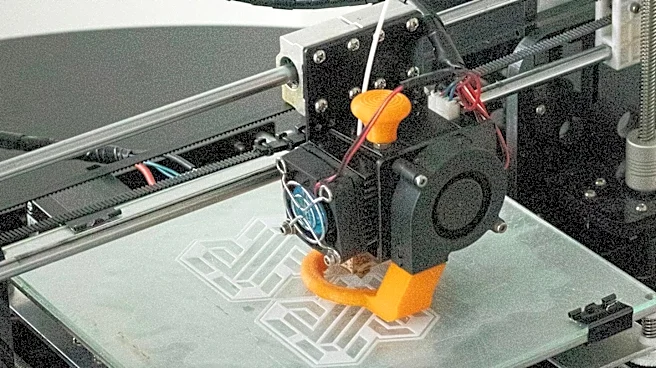
addresses limitations of conventional crystal-growing techniques by using a wire-fed, electric-arc printing process with brief high-power pulses separated by longer low-power periods. This careful alternation of heat allows for continuous crystal growth layer by layer without requiring a single-crystal starting base. The process, termed deep-squat pulsed wire arc additive manufacturing (DSP-WAAM), enables the production of single crystals of materials like tungsten, molybdenum, niobium, and molybdenum–niobium alloy, and even support-free zigzag lattices with single-crystal struts.
Why It's Important?
This breakthrough has significant implications for U.S. industries requiring high-performance materials, particularly in aerospace, energy, and manufacturing. Single-crystal metals are crucial for high-stress and high-heat applications because they lack the weak grain boundaries found in polycrystalline metals, which can deform under prolonged heat and stress. The ability to 3D print large, complex single-crystal structures that are highly creep-resistant opens new avenues for designing components that can withstand extreme environments, such as those found in jet engines, power generation turbines, and advanced reactor components. This technology could lead to more durable, efficient, and safer products, potentially reducing maintenance costs and extending the lifespan of critical infrastructure, thereby enhancing U.S. industrial competitiveness and technological leadership.
What's Next?
Further testing is required to establish the precise size limits and explore the full range of complex shapes achievable with this new method. Researchers will likely focus on optimizing the DSP-WAAM process for various materials and geometries to meet specific industrial demands. The potential for creating lightweight lattice structures for thermal protection in high-temperature environments will be a key area of investigation. While commercial advantages still need verification, the method is expected to offer a cost-effective and scalable alternative to existing, often expensive and shape-limited, crystal-growing techniques. This could lead to increased adoption in specialized manufacturing sectors and a broader availability of advanced materials for critical applications.
Beyond the Headlines
The development of this pulsed 3D printing method represents a fundamental shift in how advanced materials can be engineered and manufactured. It challenges the traditional constraints of material science by enabling the creation of previously unattainable material structures with enhanced properties. This could trigger a wave of innovation in material design, leading to entirely new classes of high-performance alloys and components. Ethically, it raises questions about the responsible deployment of such powerful manufacturing capabilities, particularly concerning their use in critical and potentially hazardous applications. Culturally, it underscores the ongoing evolution of manufacturing processes, moving towards greater precision, customization, and material efficiency, which could redefine industrial standards and practices in the U.S. and globally.