





What's Happening?
Following the recent midterm elections, the stock market experienced a substantial downturn, particularly affecting companies tied to artificial intelligence (AI) spending. Initially, the market saw a jump of 1,569 points due to relief over President
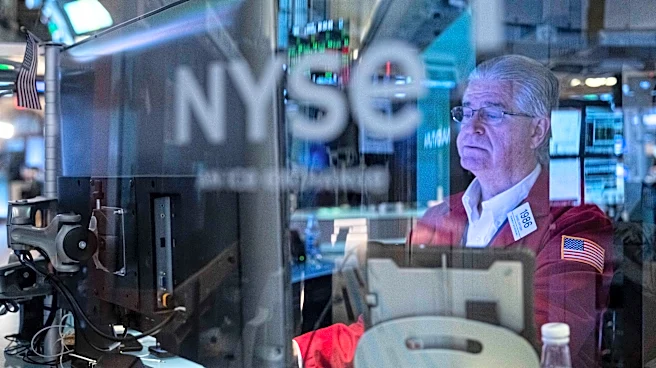
Trump accepting election results and hopes for an end to the Iran War, which could lower fuel prices. However, this positive sentiment was short-lived. The subsequent day, investors reacted to the realization that Democratic victories in the Senate, House of Representatives, and various state-level races were partly fueled by public apprehension towards AI and opposition to the construction of large data centers. This shift in perception led to an 1,833-point plunge in the stock market, resulting in a loss of approximately $2.5 trillion. Bloomberg reported on this development, highlighting Wall Street's concerns about the AI trade as midterm results exposed new risks. Peter Tuz, president of Chase Investment Counsel, noted that investors are questioning growth assumptions for data center suppliers and broadly pulling back from AI-related investments.
Why It's Important?
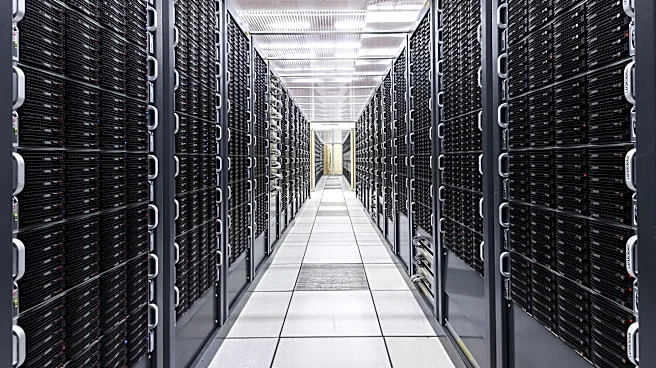
This market reaction underscores a growing tension between technological advancement and public sentiment, with significant implications for the U.S. economy and the technology sector. The substantial loss of $2.5 trillion indicates a major shift in investor confidence regarding the future of AI development, particularly concerning the infrastructure required for its expansion. The election results suggest that anti-AI platforms resonated with voters, potentially leading to increased regulatory scrutiny and local opposition to data center projects. This could slow down the growth trajectory of AI companies, impacting job creation, innovation, and the overall competitiveness of the U.S. in the global tech landscape. Companies heavily invested in AI research, development, and infrastructure, such as chip manufacturers and cloud service providers, stand to lose the most from this shift in political and public opinion. Conversely, this could signal a win for communities concerned about the environmental impact and resource consumption of large data centers.
What's Next?
The immediate future will likely see increased uncertainty in the regulatory environment surrounding AI and data center development. Companies in the AI sector may face challenges in securing permits for new facilities and could encounter more stringent oversight from state and federal governments. This could lead to a re-evaluation of investment strategies within the tech industry, with a potential shift towards more politically palatable or less infrastructure-intensive AI applications. Political leaders who campaigned on anti-AI platforms may push for legislation to regulate AI development and data center expansion, potentially impacting the operational costs and growth potential of tech giants. Stakeholders, including tech industry lobbyists and civil society groups, are expected to engage in debates over the balance between technological progress, economic growth, and public concerns regarding AI's societal impact.
Beyond the Headlines
The market's reaction to the midterm elections reveals a deeper societal debate about the role and impact of artificial intelligence. Beyond economic implications, this development highlights a growing public skepticism towards unchecked technological expansion, particularly when it involves significant resource consumption and potential societal disruption. This could trigger a broader conversation about ethical AI development, data privacy, and the environmental footprint of the digital economy. The political success of anti-AI platforms suggests a potential cultural shift where technological advancement is no longer universally viewed as inherently positive. This could lead to a more cautious approach to innovation, prioritizing public consent and societal well-being alongside economic growth. The long-term implications might include a redefinition of 'progress' in the tech sector, emphasizing sustainable and ethically aligned development over rapid, unconstrained expansion.